jpcharleaux@braziloffice.org ͏ ͏ ͏ ͏ ͏ ͏ ͏ ͏ ͏ ͏ ͏ ͏ ͏ ͏ ͏ ͏ ͏ ͏ ͏ ͏ ͏ ͏ ͏ ͏ ͏ ͏ ͏ ͏ ͏ ͏ ͏ ͏ ͏ ͏ ͏ ͏ ͏ ͏ ͏ ͏ ͏ ͏ ͏ ͏ ͏ ͏ ͏ ͏ ͏ ͏ ͏ ͏ ͏ ͏ ͏ ͏ ͏ ͏ ͏ ͏ ͏ ͏ ͏ ͏ ͏ ͏ ͏ ͏ ͏ ͏ ͏ ͏ ͏ ͏ ͏ ͏ ͏ ͏ ͏ ͏ ͏ ͏ ͏ ͏ ͏ ͏ ͏ ͏ ͏ ͏ ͏ ͏ ͏ ͏ ͏ ͏ ͏ ͏ ͏ ͏ ͏ ͏ ͏ ͏ ͏ ͏ ͏ ͏ ͏ ͏ ͏ ͏ ͏ ͏ ͏ ͏ ͏ ͏ ͏ ͏ ͏ ͏ ͏ ͏ ͏ ͏ ͏ ͏ ͏ ͏ ͏ ͏ ͏ ͏ ͏ ͏ ͏ ͏ ͏ ͏ ͏ ͏ ͏ ͏ ͏ ͏ ͏ ͏ ͏ ͏ ͏ ͏ ͏ ͏ ͏ ͏ ͏ ͏ ͏ ͏ ͏ ͏ ͏ ͏ ͏ ͏ ͏ ͏ ͏ ͏ ͏ ͏ ͏ ͏ ͏ ͏ ͏ ͏ ͏ ͏ ͏ ͏ ͏ ͏ ͏ ͏ ͏ ͏ ͏ ͏ ͏ ͏ ͏ ͏ ͏ ͏ ͏ ͏ ͏ ͏ ͏ ͏ ͏ ͏ ͏ ͏ ͏ ͏ ͏ ͏ ͏ ͏ ͏ ͏ ͏ ͏ ͏ ͏ ͏ ͏ ͏ ͏ ͏ ͏ ͏ ͏ ͏ ͏ ͏ ͏ ͏ ͏ ͏ ͏ ͏ ͏ ͏ ͏ ͏ ͏ ͏ ͏ ͏ ͏ ͏ ͏ ͏ ͏ ͏ ͏ ͏ ͏ ͏ ͏ ͏

Jun 12 2026| Nº. 209

Editorial


Brazil’s 2026 presidential election continues to shape the country’s main political developments. The Genial/Quaest poll released this week reinforced an important shift observed since the revelations surrounding the Master Bank case and the financing of the film Dark Horse. President Luiz Inácio Lula da Silva expanded his lead over Senator Flávio Bolsonaro in a hypothetical runoff election, moving from a statistical tie recorded in May (42% to 41%) to a six-point advantage in the latest survey, with 44% of voting intentions against Bolsonaro’s 38%. The result strengthens the perception that the recent controversies affecting the opposition’s leading figure are beginning to produce tangible effects on the electoral landscape. Although the election will only take place in October, the numbers have fueled debate about the opposition’s ability to sustain its current presidential strategy and increased internal pressure for alternative conservative candidates.

At the same time, the electoral dispute is increasingly affecting the functioning of Brazil’s institutions. In Congress, the government faces new challenges in preserving its economic and fiscal agenda. Senate President Davi Alcolumbre has advanced proposals that would increase public spending (see below). The advancement of these measures highlights that governability will remain one of the central challenges during the second half of Lula’s term.

In the economic sphere, another institutional dispute emerged with the proposal to expand the administrative and financial autonomy of the Central Bank (see below). The initiative deepens disagreements between the government and the opposition regarding the limits of autonomy for economic institutions and the role of the state in monetary policy and national development.

Meanwhile, developments surrounding the film Dark Horse continue to generate political repercussions. New reports published by the press point to possible connections between financing structures linked to the film’s production and companies that appear in investigations involving suspicious financial transactions and money laundering schemes (see below). According to recent reporting, resources directed to the project may have passed through companies connected to investment funds and financial institutions under investigation for indirect links to organized crime networks.

The 2026 presidential race is already influencing economic decisions, reshaping political alliances, affecting the functioning of institutions, and redefining the strategies of the country’s main political actors.


Highlights

  • Dark Horse. The U.S. film Dark Horse, which tells a distorted and laudatory biography of Jair Bolsonaro, may have received funding from the company Entre Investimentos e Participações that, in turn, received money transfers from the investment fund Gold Style, investigated for making transactions with BK Bank that allegedly has links to the criminal organization Primeiro Comando da Capital (PCC), according to revelations made by the newspaper Folha de São Paulo. The newspaper's report amplifies the political crisis of pre-candidate Flávio Bolsonaro, who is trying to explain the recorded audios where he negotiates the financing of the film using resources from the imprisoned banker Daniel Vorcaro, owner of Banco Master.

  • Budgetary bombshells. David Alcolum, the president of the Senate, has authorized voting at least three bills contrary to the interests of the Lula government. Combined, these projects represent an additional expenditure of R$ 170 billion from the public budget over the next ten years. The relationship between Lula and Alcolumbre has been strained since the Senate president worked to veto the nomination of Jorge Messias, Lula's nominee for a seat on the Brazilian Supreme Court.

  • Central Bank. Another setback for the Lula government in the economic area was the approval of the proposal that grants total administrative and financial autonomy to the Central Bank. The constitutional amendment passed through the Senate's Constitution and Justice Committee, which is responsible for assessing whether proposals have a constitutional basis. The next step is a vote in a plenary session, where it needs to receive 49 out of 81 possible votes to move forward. Along with the expansion of the Central Bank's autonomy, which displeases the government, a proposal was included to enshrine in the Constitution the free use of PIX, the public bank transfer system, which Lula defends.

  • Survey suspended. This week, Nunes Marques, president of the Superior Electoral Court, prohibited the publication of an opinion poll unfavorable to the far-right presidential candidate, Flávio Bolsonaro. Marques was appointed to the post by former president Jair Bolsonaro. The decision, taken by him in a preliminary capacity, contests the methodology used in the poll, but raises fears that it may actually be an attempt to benefit Flávio. The full court will still have to make a final decision.


News from the Alliance and partner organizations

Cerrado. On Wednesday, June 10, the Federal Government signed the decree that establishes the National Plan for Sustainable Development of Traditional Peoples and Communities (PDPCT), built with the participation of people from traditional communities, national workshops, public consultation and articulation between different government ministries. Organized into axes such as territory, infrastructure, social inclusion, sustainable production, human rights, communication, culture and training, the plan proposes goals, indicators and actions. For traditional and Afro-Brazilian peoples and communities of the Cerrado (Brazilian savannah), the PDPCT creates an opportunity to claim territorial rights, prior consultation, protection of defenders, combating environmental racism, climate finance and recognition of quilombolas (communities of descendants of former runaway enslaved people), geraizeiros (distant communities in northern Minas Gerais), vazanteiros (traditional communities on the banks of the São Francisco River), and coconut breakers. The plan could become the main federal vehicle to develop policies for traditional and Afro-Brazilian communities in the coming years.

Caatinga. The Caatinga (Brazil’s semi-arid biome) has gained an unprecedented legal framework for its recovery. The law creating the National Policy for the Recovery of Caatinga Vegetation was signed into law by President Lula at the Palácio do Planalto in Brasília on Wednesday, June 10, during the Environment Week ceremony. The only 100% Brazilian biome, the Caatinga is a territory of biodiversity, water, food, memory and ways of life built by indigenous peoples, quilombolas, family farmers, and other traditional and Afro-Brazilian communities. Amidst desertification and water insecurity, the new policy can strengthen restoration, coexistence with the semi-arid region, and climate justice.

Exhibition. The Imbuzeiro Institute and partners will exhibit the visual work "Caatinga" by Anna Mariani on June 23rd in London. The exhibition will be at The Bomb Factory, 206 Marylebone, starting at 6 PM local time. The exhibition consists of records of the historical architecture of the Brazilian Northeast region, as well as its landscapes and people, captured by the photographer born in Rio de Janeiro in 1935 and raised in Salvador. Learn more.


The Brazil Office Alliance and The Brazilian Report publishes a newsletter every Tuesday with the main news from the electoral process in Brazil, written in an explanatory and analytical way. Click on the banner below to subscribe.


Article

Time to Enact the Caatinga Law

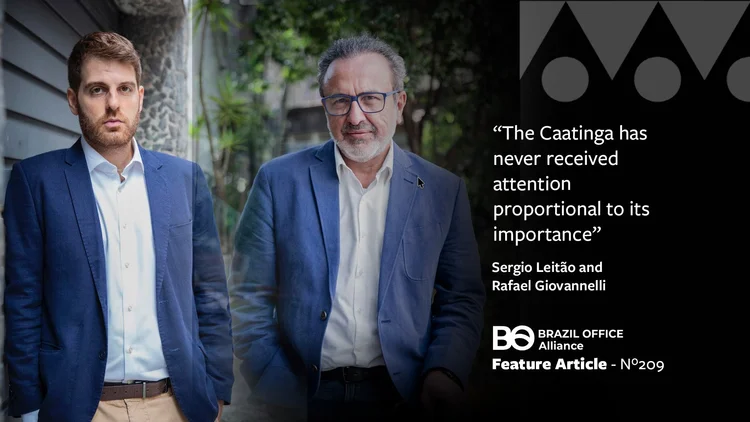
By Sergio Leitão and Rafael Giovannelli

This text was originally published in Correio Braziliense on June 9, 2026.

President Luiz Inácio Lula da Silva, who personally experienced the challenges of drought in the northeastern hinterland, has before him the opportunity to correct a historical omission and transform the recovery of the Caatinga, a semi-arid biome in northeastern Brazil,” into a permanent commitment of the State. The enactment of Bill 1990/2024, approved by the Brazilian Congress, will institute the National Policy for the Recovery of Caatinga Vegetation, creating the first Brazilian legal framework specifically aimed at the recovery of a biome.

The importance of this decision goes far beyond environmentalism. What is at stake is the construction of a national development strategy for the semi-arid region, based on water security, sustainable food production, job creation, adaptation to climate change, and combating desertification.

The Caatinga has never received attention proportional to its importance. For decades, it was treated as a landscape of scarcity, when in reality it constitutes the ecological infrastructure that sustains the lives of millions of people in the Northeast of Brazil. Reservoirs, rivers, production systems, and urban centers depend directly on the environmental services provided by this biome.

The degradation of native vegetation compromises water infiltration into the soil, reduces agricultural productivity, amplifies the effects of droughts, and increases the economic vulnerability of rural populations. Therefore, restoring the Caatinga is the most efficient way to strengthen the material conditions that allow for the development of the Northeast.

The new law is particularly relevant because it offers something that the Caatinga lacked: institutional stability. Government programs are important, but they can be reformulated, reduced, or even discontinued over time. A public policy enshrined in law creates permanent commitments for the Brazilian State, establishes clear objectives, guides the actions of different public bodies, and offers greater predictability for public and private investments.

The law also has the potential to strengthen the priority of Caatinga restoration in the competition for public resources. By establishing a specific national policy, Congress creates a more solid foundation for actions aimed at the recovery of the biome to be incorporated into government planning and receive continuous financial support over the years.

This stability is particularly important because vegetation recovery requires long-term investments. No restoration process happens in a single budget cycle or during a single presidential term. These are efforts that need to span governments and consolidate as a permanent commitment of the Republic.

Presidential approval will also allow for unity among a series of initiatives already underway. In recent years, measures such as the Eco Invest Brasil Program, the Sertão Vivo Program, the Floresta Viva — Caatinga Viva initiative, the Action Plan for the Prevention and Control of Deforestation and Burning in the Caatinga (PPCaatinga), the National Plan for the Recovery of Native Vegetation (Planaveg), and the Climate Plan have begun to direct resources and attention to the semi-arid region. The new law offers a common reference point to integrate these efforts and increase their effectiveness.

The potential results fully justify this decision. A study by the Escolhas Institute indicates that approximately 1 million hectares of degraded land in Northeast Brazil have the potential for recovery. Restoring these areas could generate approximately 465,000 jobs, produce more than 7 million tons of food, and generate nearly R$ 30 billion in net revenue. These are economic, social, and environmental benefits that extend beyond the directly restored areas.

The topic is also gaining increasing relevance on the international stage. In August of this year, Mongolia will host the Conference of the Parties to the United Nations Convention to Combat Desertification, of which Brazil is a signatory. Worldwide, governments are seeking solutions capable of simultaneously addressing land degradation, food insecurity, water scarcity, and climate change. The Brazilian semi-arid region has much to contribute to this debate.

By approving Bill 1990/2024, the National Congress recognized that the recovery of the Caatinga biome is a strategic issue for the country's future. Now, it is up to the President of the Republic to conclude this process.

There is a rare symbolic significance in this decision. The migrant from Pernambuco who left the semi-arid region to escape the limitations imposed by drought now has the opportunity to transform the recovery of the Caatinga into a national priority. In doing so, President Lula will inaugurate a new chapter in the history of the Northeast, in which drought and degradation cease to be seen as an inevitable fate, and the sustainable development of the region becomes a strategic objective of the country.


*Sergio Leitão is a lawyer, executive director of the Escolhas Institute, former advisor on indigenous and environmental issues at the Ministry of Justice, and executive director of the Socio-environmental Institute.

*Rafael Giovanelli is the Research Manager at the Escolhas Institute, and holds a doctorate and master's degree in Law and Development from FGV Direito SP.


External articles express the opinions of their authors and do not necessarily reflect the positions of Brazilian Alliance or the editors of the bulletin.

 
Washington Brazil Office
twitter
Subscribe

1611 Connecticut Ave., NW Suite 400
Washington, DC 20009
United States

Powered by Squarespace

Unsubscribe