jpcharleaux@braziloffice.org ͏ ͏ ͏ ͏ ͏ ͏ ͏ ͏ ͏ ͏ ͏ ͏ ͏ ͏ ͏ ͏ ͏ ͏ ͏ ͏ ͏ ͏ ͏ ͏ ͏ ͏ ͏ ͏ ͏ ͏ ͏ ͏ ͏ ͏ ͏ ͏ ͏ ͏ ͏ ͏ ͏ ͏ ͏ ͏ ͏ ͏ ͏ ͏ ͏ ͏ ͏ ͏ ͏ ͏ ͏ ͏ ͏ ͏ ͏ ͏ ͏ ͏ ͏ ͏ ͏ ͏ ͏ ͏ ͏ ͏ ͏ ͏ ͏ ͏ ͏ ͏ ͏ ͏ ͏ ͏ ͏ ͏ ͏ ͏ ͏ ͏ ͏ ͏ ͏ ͏ ͏ ͏ ͏ ͏ ͏ ͏ ͏ ͏ ͏ ͏ ͏ ͏ ͏ ͏ ͏ ͏ ͏ ͏ ͏ ͏ ͏ ͏ ͏ ͏ ͏ ͏ ͏ ͏ ͏ ͏ ͏ ͏ ͏ ͏ ͏ ͏ ͏ ͏ ͏ ͏ ͏ ͏ ͏ ͏ ͏ ͏ ͏ ͏ ͏ ͏ ͏ ͏ ͏ ͏ ͏ ͏ ͏ ͏ ͏ ͏ ͏ ͏ ͏ ͏ ͏ ͏ ͏ ͏ ͏ ͏ ͏ ͏ ͏ ͏ ͏ ͏ ͏ ͏ ͏ ͏ ͏ ͏ ͏ ͏ ͏ ͏ ͏ ͏ ͏ ͏ ͏ ͏ ͏ ͏ ͏ ͏ ͏ ͏ ͏ ͏ ͏ ͏ ͏ ͏ ͏ ͏ ͏ ͏ ͏ ͏ ͏ ͏ ͏ ͏ ͏ ͏ ͏ ͏ ͏ ͏ ͏ ͏ ͏ ͏ ͏ ͏ ͏ ͏ ͏ ͏ ͏ ͏ ͏ ͏ ͏ ͏ ͏ ͏ ͏ ͏ ͏ ͏ ͏ ͏ ͏ ͏ ͏ ͏ ͏ ͏ ͏ ͏ ͏ ͏ ͏ ͏ ͏ ͏ ͏ ͏ ͏ ͏ ͏ ͏ ͏

Jul 31 2026| Nº. 215

Editorial

With the progress of national conventions, the Brazilian presidential election is entering a new phase. The focus of the contest is gradually shifting from the definition of candidacies to the consolidation of state-level alliances, where much of the key contenders' political mobilization capacity will be determined.

Decisions made by parties in recent days show that the electoral landscape remains fragmented. The MDB, União Brasil, PP, and other parties have adopted flexible strategies at the national level, granting greater autonomy to their state leaders to form alliances based on the political realities of each state. The result is an increasingly decentralized electoral map, in which local contests exert growing influence over the presidential dynamic.

The first polls released following the official opening of the conventions reinforce this perception. In São Paulo—the country's largest electoral district—Governor Tarcísio de Freitas maintains a comfortable lead in his race, while the presidential contest presents a more competitive scenario between Luiz Inácio Lula da Silva and Flávio Bolsonaro. Meanwhile, recent surveys in Minas Gerais, Rio Grande do Sul, Ceará, and other states reveal widely varying configurations, indicating that a uniform electoral dynamic across the national territory is unlikely.

This process also impacts the presidential candidacies themselves. The difficulties Flávio Bolsonaro faces in consolidating alliances in strategic states, the maneuvers by leaders like Ronaldo Caiado to expand their influence within the right-wing camp, and the choice by centrist parties to adopt neutral or flexible stances all demonstrate that the national contest will increasingly depend on the ability to coordinate state-level coalitions. At the same time, the government seeks to preserve its advantage in key electoral strongholds, aware that even slight shifts in decisive states like Minas Gerais and Bahia could significantly alter the national outcome. The 2026 presidential campaign is thus beginning to take on a characteristic feature of Brazilian politics: the race for the Presidency is contested nationally but built state by state. Rather than a single presidential race, the country is witnessing the simultaneous formation of various regional political landscapes; the alliances, candidacies, and unique dynamics within these arenas will likely determine the political balance that emerges from the polls in October.


Highlights

  •  Diplomacy 1. Relations between Brazil and Argentina hit a historic low this week—marking the worst point in over 200 years of bilateral ties—after President Javier Milei called President Lula a "convict" and Supreme Court Justice Alexandre de Moraes "bald trash." These remarks were made during a speech at the party conventions that confirmed Flávio Bolsonaro as the PL’s presidential candidate. In response, the Brazilian Foreign Ministry summoned the Argentine ambassador in Brasília for an explanation and recalled the Brazilian ambassador from Buenos Aires.

  • Diplomacy 2. Paraguay’s Foreign Ministry summoned the Brazilian ambassador in Asunción to provide clarifications regarding a statement President Lula made this week concerning the war between the two countries in 1864. Lula mentioned the Paraguayan War in passing to illustrate how, in the past, disputes between nations could spiral into protracted wars. The subject is sensitive in Asunción, where the conflict is viewed as the most significant negative event in the nation's history, with Brazil held entirely responsible for the war. Like Argentina, Paraguay is governed by a right-wing administration seeking to expand its influence across the region.

  • Elections 1. Brazil denied visas to two US officials whom Donald Trump intended to send to sow distrust in the Brazilian electronic voting system. Subsequently, Democrats on the U.S. Senate Foreign Relations Committee posted a message on X accusing the administration itself of “spreading conspiracy theories” regarding the Brazilian elections. The country also denied authorization for a Spanish NGO to accredit its own observers; the organization is linked to the international far-right. Both incidents demonstrate how observation missions will become a focal point of this year's contest.

  • Elections 2. Justice Alexandre de Moraes has demanded an explanation from Jair Bolsonaro regarding the use of an AI-generated message in which the former president appears to endorse the campaign of his son, Flávio Bolsonaro. The video was publicly screened at the campaign launch ceremony in São Paulo. Jair is prohibited from posting messages online, whether personally or through third parties. Violating this ban could result in his return to prison under a closed regime. Consequently, he denied any knowledge of the video. As a result, Flávio’s campaign has come under scrutiny for using deepfake technology—which is banned by the Electoral Court in materials criticizing opponents and in those promoting the campaign itself. The matter is expected to be reviewed by the Electoral Court.

  • Indebtedness. In Brazil, 28.5% of household income was committed to overdue debt payments in May. This marks the highest level in the indicator's historical series, tracked by the Central Bank since March 2011. Debt and delinquency affect 49.8% of the Brazilian population. To mitigate this issue, the government has been relaunching debt renegotiation programs, such as Desenrola. More than R$ 22 billion had been allocated to the program as of July 23.

  • Investigation. President Lula’s son has become the subject of a request by the Federal Police to the Supreme Federal Court to open an inquiry. Businessman Fábio Luís Lula da Silva—known as Lulinha—is alleged to have been involved in corruption and influence-peddling related to the sale of medical cannabis within the scope of Ministry of Health programs. The president's son was already facing political fallout following revelations that a key figure in the Social Security fund embezzlement scandal had covered some of his expenses. The Ministry of Health case adds further complications for Lula as he prepares to launch his re-election campaign. News from the Alliance and partner organizations


News from the Alliance and partner organizations

 Digital media. Democracia em Xeque has released the 17th edition of its report on "weekly political narratives in digital environments and their impacts on democratic integrity in Brazil." The publication is a key resource for anyone wishing to follow the dynamics of the ongoing political contest in Brazil’s digital landscape and can be accessed at this link.

Cerrado and Caatinga. A study published in the journal Science Advances revealed that large pre-colonial villages in the Cerrado—home to up to 2,000 inhabitants—were sustained by diversified agricultural systems based on maize cultivation. Led by researchers from the University of São Paulo (USP), with support from the São Paulo Research Foundation (FAPESP) and in partnership with Brazilian and international institutions, the study analyzed human remains from 37 archaeological sites. It identified practices such as polyculture, irrigation, and crop rotation adapted to the biome. The findings challenge the notion that these populations relied primarily on hunting and gathering or monoculture, instead highlighting the sophisticated agricultural knowledge possessed by the peoples who inhabited the Cerrado prior to colonization. The study also reinforces the understanding that conserving the biome is linked to valuing traditional knowledge and historical land-management practices.

IACHR. The Inter-American Commission on Human Rights (IACHR) has released the schedule for its 196th Period of Sessions. The sessions will take place in person in Washington, D.C., from August 3 to 7, featuring 30 public hearings on priority issues for the region. Brazil will be the subject of two thematic hearings: "Impacts of therapeutic communities on human rights" and "Structural inequalities in access to justice." The agenda also includes regional hearings on environmental justice, digital infrastructure and platform accountability, national human rights institutions, and the rights of women, girls, and LGBTIQ+ individuals—all strategic topics for civil society organizations engaged in international human rights advocacy and promotion.


The Brazil Office Alliance and The Brazilian Report publishes a newsletter every Tuesday with the main news from the electoral process in Brazil, written in an explanatory and analytical way. Click on the banner below to subscribe.


Article

Your Excellencies, the Facts Regarding the Tariff Crisis


By Mauro Vieira

Unanimity is not to be expected in democratic regimes. However, in the face of the United States' new tariff-based attack on Brazil—and the admitted political motivations behind it, dating back to President Donald Trump’s original letter of July 2025 (which contained clear threats to Brazilian sovereignty and democracy and announced the launch of the Section 301 investigation that has now concluded)—there is no room for ambiguity or false equivalencies.

Brazil has been under attack for over a year, and the government has successfully defended the national interest with diplomacy and pragmatism, as well as firmness and clarity. Clarity is precisely what the country needs most as it confronts a historic challenge to its sovereignty—one being imposed from the outside through threats, tariffs, and bluster.

The timeline of the current offensive against Brazil leaves no doubt as to which Brazilians worked against the national interest to secure impunity for those who failed in an attempted coup d'état. These Brazilians, led by former Congressman Eduardo Bolsonaro, continue to push for foreign interference in Brazil. As Ulysses Guimarães might have said, "Your Excellency, the Facts," asserts itself here. The authorship of these threats and the massive tariff hike is not a matter of opinion; indeed, the authors themselves claimed credit for them at the time in posts and interviews.

Faced with the multiple challenges of the past year, the Brazilian government’s primary course of action has been negotiation. Brazil’s willingness to engage is amply demonstrated by more than 30 contacts and meetings with Washington on tariffs, particularly during the Section 301 investigation. Since the original sweeping tariff measure was ruled illegal by the U.S. Supreme Court, invoking Section 301 of the 1974 U.S. Trade Act became the alternative Washington found to maintain unilateral actions—not only against Brazil but also against its major global trading partners, as evidenced by the new 12.5% ​​tariff announced yesterday.

In Brazil’s case—the first to be hit by Section 301 sanctions—the U.S. side never showed any openness to balanced negotiations, even regarding the most glaring instances of interference and specious arguments, such as those concerning Pix and deforestation. What was proposed to Brazil amounted to a form of surrender, involving the full opening of Brazilian industrial sectors exclusively to the United States, without any reciprocal trade-opening measures. The Brazilian private sector has never accepted capitulation on such terms in past foreign negotiations, nor would it ever accept it now. The ethanol issue is a prime example: while the United States demanded significant tariff reductions, it refused even to discuss its own high tariffs on Brazilian sugar—which exceed 80%. This U.S. stance follows a pattern recently observed with other countries, characterized by threats and unilateral actions.

Any unilateral concession granted exclusively to a specific country would be illegal under Brazil’s international commitments to the World Trade Organization and would inevitably be challenged in Brazilian courts by the affected sectors. The terms proposed by the United States—which we tried to reverse until the very end—did not constitute a negotiation, but rather an attempt to impose the law of the strongest. Furthermore, there was a clear political bias, as evidenced by the aggressive social media post from the U.S. Secretary of State, in which he arrogated to himself the right to decide what is best for Brazilians while gratuitously attacking the president of a friendly nation. 

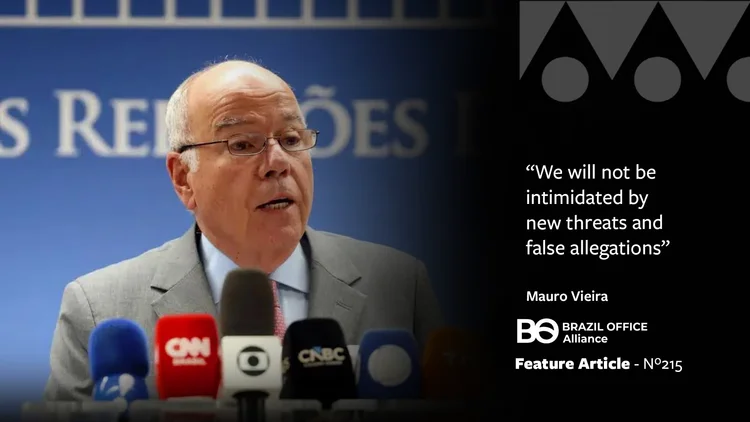
We remain willing to negotiate, but we will not be intimidated by new threats and false allegations. It is worth remembering that for dialogue and results to occur, we depend on the other party's willingness to negotiate. Brazilian diplomacy is known for its professionalism and has already succeeded in expanding the list of exceptions to the original massive tariff hike. We will continue working to find solutions to a crisis instigated by Brazilians who operate openly against the country and enjoy protection and political support from sectors of the international far-right. Given the damage caused, we cannot remain silent regarding those behind this interference. After all, Brazil and the Brazilian people are paying a heavy price for this irresponsibility.


By Mauro Vieira, Brazil’s Minister of Foreign Affairs. This article was originally published in the July 24, 2026, edition of the newspaper O Globo and was kindly provided by the author for reproduction in the Brazil Office Alliance newsletter.


External articles express the opinions of their authors and do not necessarily reflect the positions of Brazilian Alliance or the editors of the bulletin.

 
Washington Brazil Office
twitter
Subscribe

1611 Connecticut Ave., NW Suite 400
Washington, DC 20009
United States

Powered by Squarespace

Unsubscribe