
International Interference in the 2026 Elections: What to Expect
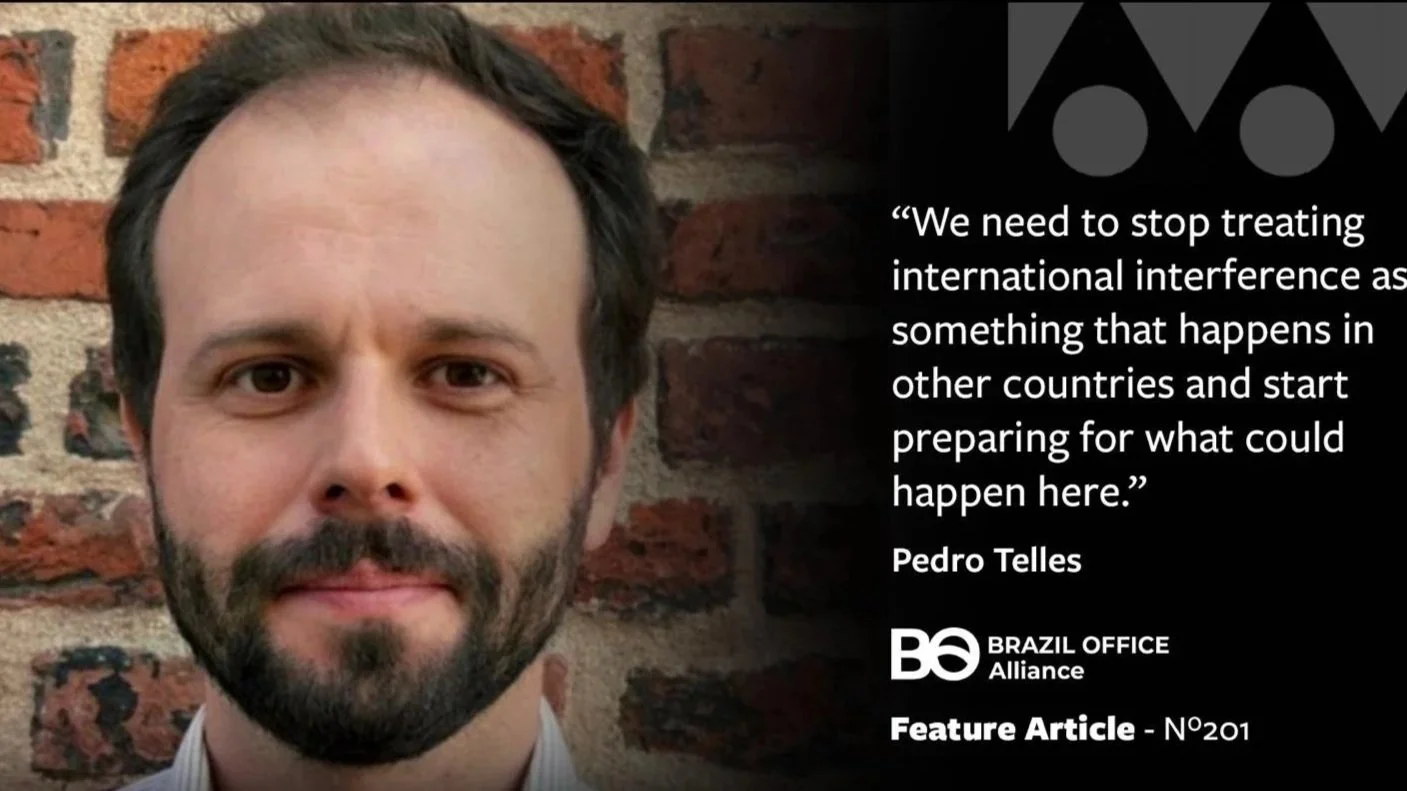
By Pedro Telles*
Authoritarian leaders around the world have developed a sophisticated repertoire for interfering in the political and electoral processes of other countries in recent years. Everything indicates that this repertoire will be used in Brazil this year, and we need to understand how it works to prepare for what may come.
Based on an extensive analysis of cases observed in various parts of the world, I have developed a risk mapping that I share here.
The focus is on interventions coming from the United States because the involvement of Trump and his allies seems much more likely than that of other international actors in Brazil in 2026, something I discuss in more detail later. But the playbook that Trump follows draws directly from figures like Putin, Orbán, and Xi Jinping.
Trump's Playbook
Trump redefined American foreign policy with a strongly ideological and transactional approach, blending the advancement of far-right agendas with the pursuit of personal political and economic gains. That approach makes constant use of endorsements, economic tools, military threats, and institutional pressure to influence other countries. It is an factor that is sometimes difficult to predict, but these forms of interferencs follow a pattern that allows for the creation of conceivable scenarios.
By analyzing how Trump and other authoritarian leaders operate, it is possible to categorize their interference into eight types:
• Endorsement of ideas, proposals, policies, and practices of allies
In 2016, Trump celebrated Brexit as a “great victory” for the English people to regain control of their country.
In 2017, he recognized Jerusalem as the capital of Israel, offering Netanyahu a historic diplomatic victory at a critical political moment.
In 2026, he came out in support of Orbán's anti-immigration policies in Hungary on the eve of elections in which the Hungarian leader is weakened.
• Opposition to ideas, proposals, policies, and practices of antagonists
In 2017, Trump harshly criticized Angela Merkel for her pro-immigration policies.
Since 2020, he has been conducting an aggressive campaign against the International Criminal Court, including executive orders with financial sanctions against judges, to halt investigations into the conduct of the United States and its allies.
In 2025, he threatened to withdraw from trade agreements that will expire with Mexico to pressure the government of Claudia Sheinbaum to change its stance on migration and security issues.
• Endorsement of allied politicians and parties
In 2019, Trump publicly endorsed Boris Johnson in the race for British Prime Minister, which he subsequently won.
In 2025, he harshly criticized the French justice system for the conviction that removed Marine Le Pen from the electoral race.
In 2026, he publicly endorsed Sanae Takaichi in the race for Prime Minister of Japan, which he successfully won.
• Opposition to antagonistic politicians and parties
In 2019, Trump recognized Guaidó as interim president of Venezuela and called on allies to do the same, in opposition to President Maduro.
Also in 2019, he pressured Ukrainian President Zelenskyy to investigate President Joe Biden and his son in exchange for proceeding with military support already approved by the U.S. Congress in an interesting case in which he used international interference to attack a domestic adversary.
• Financial support to allied politicians and parties
In 2025, Trump began paying Bukele to deport prisoners to El Salvador.
Also in 2025, he offered financial support for the stabilization of the Argentine peso explicitly linked to Milei's victory in the midterm elections.
• Threats and financial attacks against antagonistic politicians and partiesIn 2025, Trump imposed sanctions against Brazilian Supreme Court justices in retaliation for investigations against Bolsonaro.
Also in 2025, he applied high tariffs against Mexico and Canada with the explicit objective of forcing changes in domestic laws and destabilizing progressive governments.
Still in 2025, he penalized India with high tariffs for the purchase of Russian oil and for Modi's strategic autonomy.
• Threats and military attacks against antagonistic politicians and parties
In 2026, Trump conducted a direct military incursion into Venezuela to capture and extradite Maduro, culminating a campaign of maximum pressure and a total economic embargo with the objective of appropriating Venezuelan oil and ensuring the country's government's alignment with the United States.
Since the incursion into Venezuela, the Trump administration has explicitly threatened military incursions of the same kind against other countries in the region, such as Cuba and Colombia.
• Mobilization of partners to support allies
In 2026, technology companies aligned with Trump provided support to Reform UK in England to modernize its fundraising, including via cryptocurrencies.
Also in 2026, the Trump administration created the so-called Peace Council, a new multilateral space under its command that brings together allies and complicit leaders in a way that rivals the UN mandate.
It is important to note that Trump's interference often generates serious consequences for the governments and politicians he opposes, but it usually backfires in two situations: when it presents a strong threat to the country's sovereignty (e.g., Trump threatened to annex Canada, which boosted the anti-Trump candidate there, guaranteeing his victory), and when it generates a very direct and relevant impact on the population or the private sector (e.g., countries where Trump implemented tariffs significantly above the average adopted for the rest of the world, such as Brazil itself). These are situations that allow affected leaders to easily present themselves ass defenders of the people and the national interest.
What is Most Likely in Brazil?
The possibility of interference in the Brazilian elections is no longer hypothetical. In the first days of March, we had four very significant events:
Trump announced that he will classify Comando Vermelho and PCC as terrorist organizations, paving the way for a possible military intervention.
Trump attempted to send his advisor Darren Beattie to meet with Bolsonaro.
Milei offered political asylum to a Brazilian convicted for the attempted coup in 2022.
Chilean President Kast invited Flávio Bolsonaro to his inauguration, which led Lula to cancel his attendance.
All this happened shortly after Trump brought together Milei, Kast, and others at his “Shield of the Americas” summit.
Looking at the repertoire described above and what is already happening, four types of interference seem to be the most likely.
The first is the explicit and direct endorsement of far-right candidates. Given Trump's history with Johnson, Takaichi, Le Pen, Milei, and Orbán, and considering that Jair Bolsonaro is a long-time ally, a public endorsement of his son Flávio is a highly plausible scenario. The sending of Darren Beattie to meet with Bolsonaro already signals this direction.
The second is financial support, likely through promises of changes in economic cooperation between the two countries or disguised donations (given that donations from foreign entities or governments are prohibited in our elections). The Argentine precedent, where financial support was explicitly linked to Milei's electoral performance, shows that Trump has no qualms about using economic resources as an electoral tool.
The third is veiled threats of military intervention in the event of a Lula victory, which seems imminent. The classification of Comando Vermelho and PCC as terrorist organizations is, in this sense, a positioning move: it creates the conditions for a future escalation, should Trump deem it appropriate. We are not necessarily talking about a direct military intervention, but about a scenario in which implicit threats become part of the electoral calculation—something that doesn't need to materialize to be effective.
The fourth is the mobilization of foreign experts for strategic and operational support to allies. Campaign professionals, digital communication consultants, and political operatives aligned with Trump's international network can be activated to strengthen far-right Brazilian candidacies, something we have already seen happen in other countries.
It is important to note that these types of interference will likely not only come from the United States, but also from other countries in the region. Milei and Kast are already acting. The events of the first week of March show a coordination between Latin American actors aligned with Trump that goes beyond symbolic gestures. Figures like Elon Musk and Steve Bannon are also relevant actors in this ecosystem, with a history of international activity.
The Patterns Behind the Actions
Three patterns deserve special attention to anticipate scenarios in Brazil.
The first is Trump's clear transactional orientation. He rarely supports someone solely based on ideological alignment. The political or economic benefit for him needs to be evident. This makes it crucial to observe what actors on the Brazilian far-right will offer him, and also what Lula can offer as a counterweight.
The second is the gradual escalation of tension and the preference for rhetorical and economic tools. In the context of the Brazilian elections, it seems unlikely (though never impossible) that Trump will resort to direct military threats or more severe sanctions against specific actors, unless tensions between the two countries increase again for other reasons.
The third is the lack of respect for conventions, norms, and formalities. There is a real chance that Trump will not recognize the legitimacy of our electoral process, either actively (questioning the result) or passively (simply ignoring the result and letting his allies question it).
What if Trump Wants to Go Further?
Putin, Orbán, and Xi Jinping also have a long history of international interference, but not so much in Latin America. Besides using the same tactics as Trump, they go even further.
The tools that other authoritarian leaders use, but that we don't yet see Trump using, include:
The systematic construction and use of extensive disinformation networks with fake profiles, bots, and fake news websites
Restricting exports of essential resources (e.g., oil, gas) as a form of coercion
Cyberattacks to collect and leak information or destabilize public services
Long-term infrastructure investments aimed at benefiting allies
It's unlikely we'll see Trump using these tools in Brazil in 2026 because that's not yet part of how he operates, but it's not impossible. However, the trend is that he will move in that direction over time.
It also seems unlikely that figures like Putin, Orbán, and Xi Jinping will be directly involved in our elections in any significant way.
The Role of Big Tech
Large technology companies have aligned themselves politically with Trump, but with the exception of X and Musk we have no evidence of a history of their active involvement in electoral processes in the sense of taking measures to directly favor any candidate.
This does not mean that they have no impact, quite the contrary. However, their impact is associated with problems that we also observe outside of electoral contexts: permissiveness with disinformation, hate speech, irregular propaganda, and coordinated manipulation operations, in addition to algorithmic bias that favors extremist content.
It is reasonable to expect that these companies will be more permissive in 2026 than they have been in recent electoral cycles and more resistant to court orders and other measures aimed at ensuring electoral integrity. In Brazil and around the world, they seem less willing to act ethically and within the limits of the law. This requires greater firmness, proactivity, creativity, and anticipation to monitor their actions and demand diligence.
What to Do with All This
The international articulation of the far-right is nothing new, but the level of sophistication, audacity, and the volume of resources involved are on another level since the beginning of Trump's new term. We need to stop treating international interference as something that happens in other countries and start preparing for what could happen here.
This involves mapping the actors, understanding their tools and patterns, closely monitoring their movements, anticipating scenarios, and building responses—both at the institutional level and within civil society.
The Brazilian democratic field has accumulated experience in defending electoral integrity, but perhaps we are facing unprecedented risks. We need to prepare ourselves to rise to the challenge.
*Pedro Telles is the program director at Democracy Hub (D-Hub), a professor at the School of International Relations of the Getulio Vargas Foundation (FGV RI), and a senior fellow in Economic and Social Equity at the London School of Economics and Political Science (LSE).
