
Brazil Under Pressure: The Risk of New U.S. Retaliation Has Never Been Higher
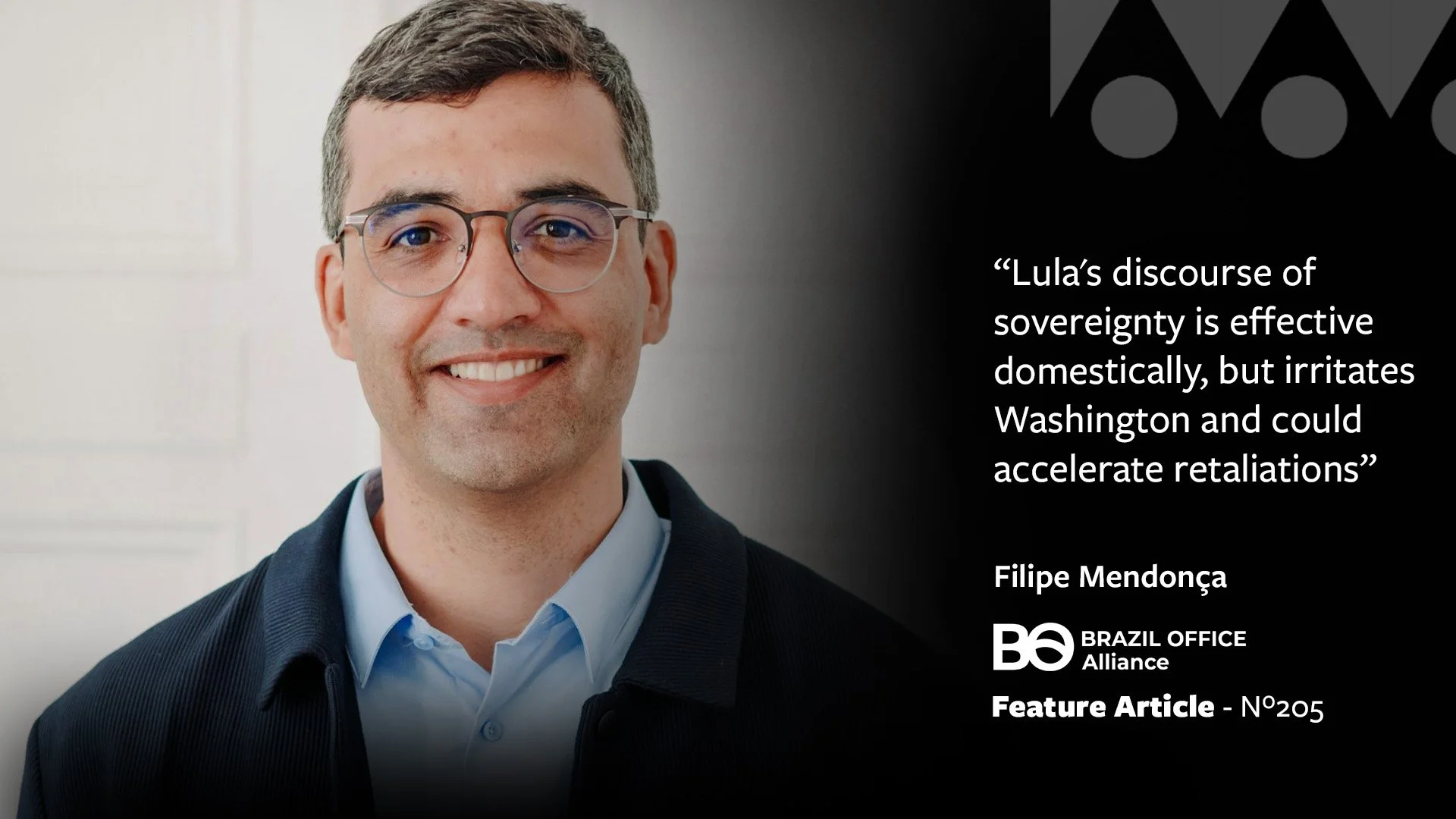
By Filipe Mendonça*
At the end of March at the 14th World Trade Organization (WTO) Ministerial Conference in Yaoundé, Cameroon, Brazil was the most forceful voice of resistance to the U.S. proposal to make permanent the moratorium on e-commerce, which had prohibited tariffs on streaming, software, and downloads since 1998. Lula maintained his position even under pressure, and the moratorium expired for the first time in 28 years. USTR Jamieson Greer, the main U.S. negotiator, warned at that time that there would be "natural consequences."
About three weeks later, during a European tour that combined a trade agenda and offensive rhetoric, Lula maintained an assertive tone towards the White House. In an interview with the German magazine Der Spiegel, published on April 16, he declared that Trump "was not elected emperor of the world." In Barcelona, on the 18th, he described the U.S. attacks on Iran as "madness." Two days later, at the opening of the Brazilian stand at the Hannover Messe, he defended multilateralism, criticized the "introduction of unilateralism" as the driving force behind relations between powerful nations and smaller countries, and stated that "the world cannot be run by lies." The speeches were received with enthusiasm in Europe and with popular approval in Brazil. In Washington, they sounded like provocations, and when it comes to Donald Trump, provocations have consequences.
Less than three weeks later, the meeting between Lula and Trump on May 7th resulted in the creation of a bilateral working group with a thirty-day deadline to present a proposal on the Section 301 investigation and the US tariff package against Brazil. There was no joint declaration, relief from remaining tariffs, or memorandum on critical minerals. The Peterson Institute for International Economics (PIIE) called the meeting "meh" (so-so), but this interpretation underestimates what is at stake, especially for Brazil.
Behind the diplomatic anticlimax, the channel opened by the two presidents consolidates a pattern that has characterized Trump's trade policy, a pattern that intensified after the Supreme Court defeat in February: the replacement of widespread unilateral imposition with asymmetrical bilateral negotiation, mediated by legal instruments such as Section 301.
A brief history of Section 301 and the approaching deadline
In April 2025, the Trump administration implemented the so-called "Liberation Day," consolidating Trump's aggressive unilateralism in international trade. Trump chose the International Emergency Economic Powers Act (IEEPA) as the main path for his trade policy, an atypical route that gave the Executive branch broad retaliatory power, but under enormous legal uncertainty.
In the Brazilian case, the imposition of tariffs significantly higher than the global average a year ago signaled a deliberate convergence between trade policy and political retaliation, distancing itself from the technical parameters of traditional safeguards.
At that time, Brazil became the target of a multidimensional pressure strategy, in which access to the U.S. market was instrumentalized as a tool for punishing misalignments in multilateral forums or divergences in foreign policy agendas.
Trump's strategy worked for a while, but the legal battles eventually came, and on February 20th, Trump's trade policy suffered its most significant setback to date. The jurisprudence established by the United States Supreme Court in the case of Learning Resources, Inc. vs. Trump consolidated a significant restriction on the Executive Branch's authority in conducting trade policy through the IEEPA to impose discretionary tariffs under the pretext of a national emergency. In short, the court's majority decision made the trade policy adopted by the United States until then illegal.
With the IEEPA failing, the aggressive unilateralism of Trumpism 2.0 mobilized three other instruments to pursue its trade policy:
Section 122 of the Trade Act of 1974 — authorizes temporary tariffs of up to 15% to correct imbalances in the balance of payments;
Section 232 of the Trade Expansion Act of 1962 — allows tariffs based on national security claims;
Section 301 of the Trade Act of 1974 — the main mechanism for retaliation against trade practices considered unfair.
Unlike the IEEPA, these three instruments contain explicit legal authorization from Congress to impose tariffs, which gives them more robust legal protection and greater political durability.
Here, again, Brazil stands out. As early as July 2025, the United States Trade Representative (USTR) opened a formal investigation against Brazil under Section 301 of the Commerce Act of 1974, the same mechanism used against China in 2018 that generated billions in tariffs. The investigation covers six areas: Pix (Brazil's instant payment system), preferential tariffs, ethanol, deforestation, intellectual property, and political-judicial interference.
Public hearings have already taken place. The final determination is expected by the middle of this year, probably between July and September. But unlike the IEEPA, Section 301 operates within the statutory powers of the Executive branch, which gives it much greater legal protection, as well as its own flow and timeline. The working group created on May 7 does not have the formal power to suspend the investigation, although it can politically influence the USTR's final recommendations. In practice, if the USTR concludes that Brazil engages in unfair trade practices, Brazil will be the target of retaliation.
Prepare, not just react
Historically, Brazil's repertoire of responses to unilateral U.S. pressures has always involved, in some way, trade multilateralism, with varying results. With the paralysis of the WTO and the tensions in Yaoundé, the current Brazilian response almost exclusively prioritizes direct negotiations with the USTR, which signals, even without admitting it, that the multilateral route has become useless. But by accepting the thirty-day working group, the Lula government is operating, in practice, within the institutional framework of Convention 301, and not outside of it.
For Brazil, in the most optimistic (and least likely) view, the working group's proposal will lead to the suspension of additional tariffs and the partial dismissal of Convention 301, with specific concessions on some issues, such as ethanol and anti-dumping mechanisms. In the most pessimistic (and most likely) scenario, the working group makes no progress, and the July report serves as the basis for new tariffs, now legally shielded from challenges by the Supreme Court.
The Brazilian electoral calendar makes the equation more complex. Lula's discourse of sovereignty, as in Hannover, is effective domestically, but irritates Washington and could accelerate retaliations. Trump, in turn, has a direct interest in the dispute, and a massive tariff increase before the elections will be interpreted in Brasília as political pressure disguised as a trade dispute.
It is necessary to recognize the critical window that opens in the coming months. Even after the May 7th meeting, the risk of retaliation is high, has a date, and grows with each new chapter of the dispute. The Brazilian democratic camp needs to be prepared to respond firmly, without underestimating the costs of a new massive tariff increase, even if segmented, in the midst of the electoral calendar.
*Filipe Mendonça is a professor at the Federal University of Uberlândia (IERI/UFU), Fellow Researcher at the Academy of International Affairs NRW, Bonn, and associate researcher at INCT-INEU.
