
Brazilian Election Results in Concentration of Power and Alignment with the US
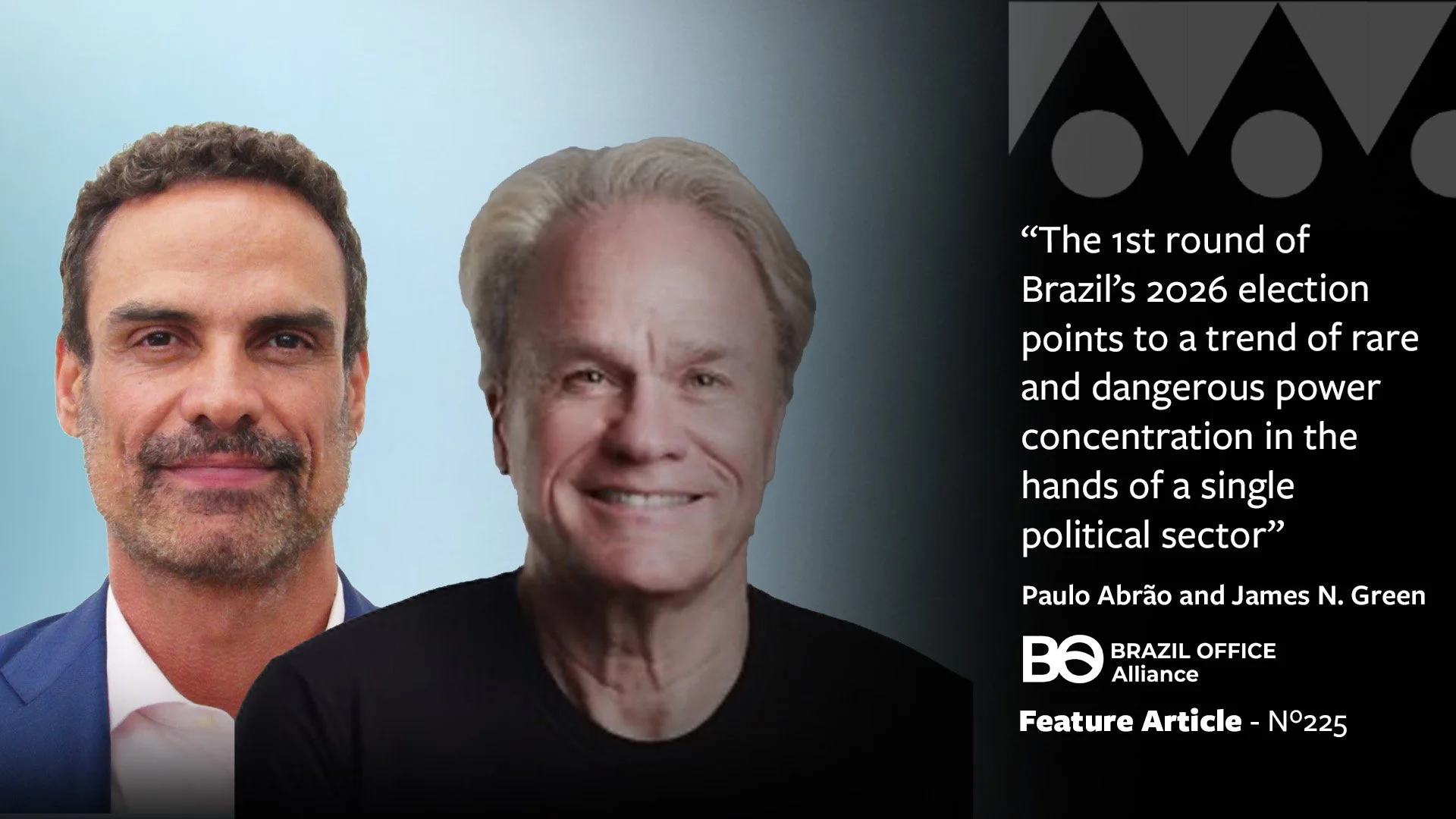
By Paulo Abrão* and James N. Green**
The first round of Brazil’s 2026 presidential election points to a trend of rare and
dangerous power concentration in the hands of a single political sector: the far right and its allies.
The PL (Liberal Party), the leading force of this sector, finished this first stage of the presidential race as the frontrunner—Flávio Bolsonaro secured 47.03% of the vote, while President Lula came in second with 45.16%.
The two will face off in the runoff on October 25, when one of two historical
precedents will be broken: no candidate who finished the first round in second place has ever managed to overcome that deficit in the runoff. Conversely, no presidential candidate seeking re-election for the PT (Workers’ Party) — Lula’s party — has ever lost a race, as Dilma Rousseff won re-election in 2014 and Lula himself was re-elected in 2006.
The outcome of the presidential race, therefore, remains undecided. However, two other facts are already firmly established and widely recognized. The first is the hegemony achieved by the far right and its allies in the National Congress.
In the Chamber of Deputies, the Liberal Party (PL)—the party of the Bolsonaro
family—gained 23 seats, reaching a total of 121 in a legislative body of 513 members. When adding the seats held by allies from the Progressive Party, União, and Republicanos, that figure rises to 249.
In the Senate, the PL also became the largest party after adding 13 seats last Sunday to the 15 it previously held. The party now holds 28 of the 81 seats in the chamber. When senators from allied parties are included, that figure reaches at least 45.
What the data show, therefore, is majority control of the legislative branch and a
strong chance of controlling the country’s highest executive office. But that is not all: the next Brazilian president will have the right to appoint at least 4 of the 11 justices to the Supreme Federal Court — the highest body of the Judiciary. Two of the current members — Kássio Nunes Marques and André Mendonça — were appointed by Jair Bolsonaro while the former president was still in office. Flávio Bolsonaro could appoint the next four if he wins the runoff election.
As things stand, the Republic’s checks and balances could become so enfeebled by the far right's hegemony and its allies that they will barely function. The opposition in Congress will be a minority, while the Judiciary will be handed over to a new wave of judges compliant with the ruling power—with a growing possibility that this control will ultimately be crowned by the return of a member of the Bolsonaro family to the Presidency.

All of this is taking place within democratic rules. The extremist faction that failed in its 2023 coup attempt is, this time, winning by the book. Yet, this clean victory could lead to a government with concentrated power—one that will almost certainly use its hegemony to secure the release and amnesty of the coup plotters. Such a move would represent not only a massive institutional setback but also a heightened risk of Brazil reliving the insecurity and instability caused by a group of civilians and military personnel who have already been declared outlaws. Finally, it is worth noting that all of this is unfolding in tandem with the current U.S. administration, in which an equally authoritarian leader is playing hardball to ensure Brazil follows the path of most of its Latin American neighbors and installs a government aligned with his own.
For organized civil society, the press, and academia, the coming four years will be a time not only for vigilance and redoubled political combativeness but also for concern regarding the preservation of their own vital space—a space frequently threatened by the far right wherever it achieves such sweeping hegemony, backed by such a powerful external actor.
*Paulo Abrão is the Executive Director of the WBO (Washington Brazil Office). He formerly served as Brazil’s National Secretary of Justice. He also served as Executive Secretary of the Inter-American Commission on Human Rights of the Organization of American States and as Director of the Mercosur Institute of Human Rights. He was a visiting scholar at the Watson Institute for International and Public Affairs at Brown University.
**James N. Green is Professor Emeritus of Brazilian History and Culture at Brown University, the author or co-editor of twelve books on Brazil, and Chair of the Board of Directors of the WBO (Washington Brazil Office).
