
Election Chess, Geopolitics, and the Real Game Behind the Dispute
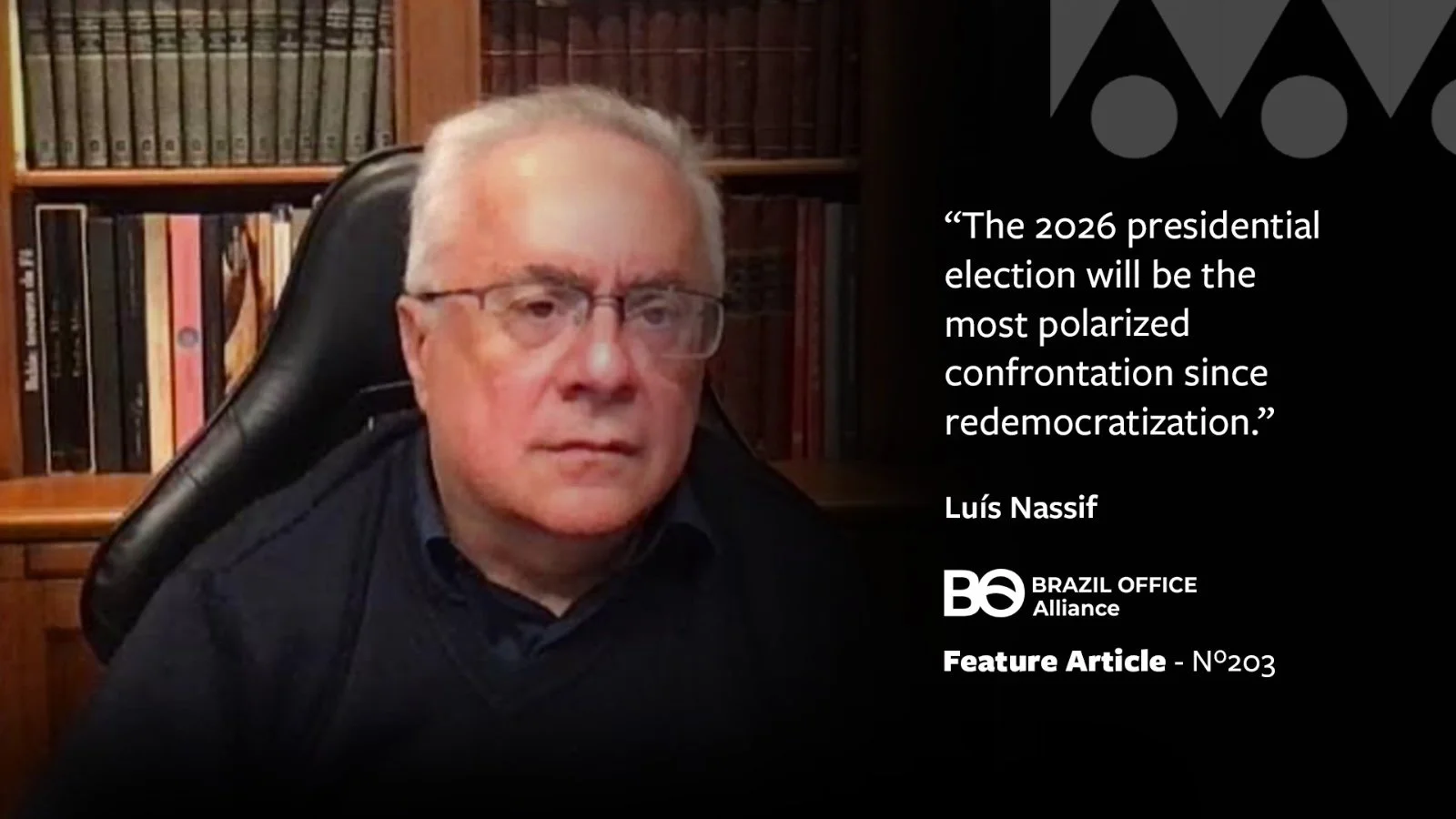
By Luís Nassif*
This article was originally published in Jornal GGN on March 17, 2026, and kindly provided for reproduction in the weekly newsletter of the Aliança Brazil Office.
The 2026 presidential election will be the most polarized confrontation since redemocratization. The clash is a referendum, with no competitive third option on the horizon: on one side, President Luiz Inácio Lula da Silva; on the other, Senator Flávio Bolsonaro.
But the chess game is much more complex. The real scenario involves economics, geopolitics, a war of narratives, digital platforms, and a series of external variables that could reshape the board.
What follows is a structured analysis of the six power centers that organize the dispute, the three most likely scenarios, the specific risks of each candidacy, and—ultimately—the question that could decide everything.
I. The Paradox That Defines the Scenario
Brazil, as it approaches 2026, faces a contradiction: macroeconomic indicators are reasonable, but the daily feeling is one of a tightened economy. Projected growth hovers around 2.3%, unemployment is at historically low levels, and inflation is operating within the target range. However, the Selic rate, around 15%, acts as a handbrake on the real economy.
The cost of credit erodes family budgets, especially those of the middle class, who feel they are working only to pay interest. Home financing, credit card interest, small business credit: all of this weighs much more heavily on the mood of the elevator than any variation in GDP. The market projects the Selic rate falling to around 12% by the end of 2026; but, if this relief is not felt in practice before the elections, these good numbers will not reduce the feeling of unease among families.
This paradox. An election that wins in the indices but loses in perception is a lost election. And the government that fails to translate economic performance into future expectations will be on shaky ground — even with the data in its favor.
GDP grows. The mood in the country is tense
That is the central dilemma for the incumbent in 2026.
II. The Two Sides of the Chessboard
Lula: Assets and Narrative Risk
Lula enters the race with three structural advantages: the federal government apparatus, the social memory accumulated over four terms, and anti-Bolsonarism as a cohesive force. Democratic legitimacy also weighs in his favor: the president who survived the 2023 coup attempt carries a symbolic asset that no indicator can artificially produce.
But his greatest risk is hisn narrative. A government that delivers good numbers without translating that into daily experience risks becoming a manager of the present—and, in political practice, a manager of the present is an easy target for those who sell change. The fatigue of a fourth term, the absence of a future project in simple language, and the tendency to react instead of setting the agenda are his greatest vulnerabilities.
There is also the risk of underestimating the digital ecosystem of the right. The 2026 election will feature artificial intelligence, short videos, religious networks, moral outrage, and campaigns of emotional content on an unprecedented scale. The Superior Electoral Court (TSE), which oversees the electoral process, has already approved specific rules for the electoral cycle, including restrictions on the use of AI, precisely because it recognizes this risk. Ignoring it would be a serious strategic error.
Flávio Bolsonaro: The legacy and the Challenge of Moderation
Flávio Bolsonaro inherits a brand, a base, and an ecosystem. The surname mobilizes three well-organized networks with a high capacity for engagement: religious conservatism, digital Bolsonarism, and the right wing linked to agribusiness and the security forces. It is a solid, loyal, and highly motivated base, which guarantees a good starting position in any scenario.
But the structural problem is clear: to win, it is not enough to hold onto the base. It is necessary to reduce rejection outside of core support. That is why the so-called “moderate Flávio operation” makes so much strategic sense in the attempt to repackage his candidacy with a responsible right-wing tone, palatable to the financial market and the urban centrist voter who rejects radicalism but also rejects the Workers' Party (PT).
The obstacle is that this moderation is staged, and the opposing campaign will certainly try to make that evident. The Bolsonaro clan's history, including the kick back (rachadinha) scandal and its widely documented ties to militias, weighs less on the hardline base and more on the centrist voters that the opposition needs to win over. Changing the tone of his voice without changing the content of his message is a risky operation when the opponent has a direct interest in dismantling it.
II. The Six Real Centers of Power
The election will not be decided solely at the ballot box. There are six forces organizing the game and operating simultaneously, sometimes in opposing directions.
1. The Popular Vote
It remains the central axis, but it is fractured into two distinct emotional blocks. Lula tends to perform better where income, social memory, and fear of a Bolsonaro return weigh heavily. Flávio grows where anti-PT sentiment, moral conservatism, public safety, and rejection of the “traditional political system” weigh heavily. The election will be decided by which of these emotions—relief or resentment-- manages to mobilize more undecided voters.
2. The Power of Money
The market doesn't elect a candidate on its own, but it defines what analysts call the “viability climate” of a candidacy, namely, that diffuse perception of whether a name is or is not a serious option. If interest rates fall and income improves before the elections, Lula gains oxygen. If the cost of credit continues to crush businesses and families, the opposition gains a narrative edge. The Central Bank's Monetary Policy Committee (Copom) and the electoral calendar are, therefore, deeply intertwined.
3. Traditional Media
It has lost its monopoly on influencing voting but maintains enormous sway over three things: defining the topic of the day, stabilizing or destroying reputations, and granting—or withdrawing—the label of “moderate,” “radical,” “responsible,” or “dangerous.” It is precisely this mechanism that sustains the attempt to repackage Flávio as a legitimate conservative option. In an election decided by the margins, the old idea that “it’s not quite that Bolsonaro” can make a difference if the corporate media decides to collaborate with this symbolic operation.
4. Digital Platforms
This is the hidden engine of 2026. Whoever dominates WhatsApp, Telegram, viral YouTube clips, political influencers, and religious micro-segmentation will have a more powerful persuasion machine than any physical platform. Television still carries weight; the cell phone, today, influences people’s minds. The Superior Electoral Court recognizes this.— The response from the platforms under the political protection of Washington in the name of “freedom of expression” could create what some analysts are already calling a “digital Wild West”: an environment of disinformation without effective moderation, which historically favors the right wing in its capacity to produce emotional content on a large scale.
5. The Political System
Congress, governors, the Centrão (center-right bloc), thematic caucuses in Congress, the federal apparatus — this machinery decides financing, coalitions, TV time, and territorial reach. Flávio has the potential to more easily unite sectors of the parliamentary right, agribusiness, and religious conservatism. Lula has the advantage of the federal machine and a historically broader coalition but pays the price of governing with alliances that erode his identity and hinder narrative clarity.
6. External Power
The most underestimated and potentially most decisive variable is what analysts call the "Trump Corollary." The United States has moved from being a passive observer in Latin America to operating as an active player. The reclassification of Brazilian organized crime—PCC and CV—as regional threats and potential terrorist organizations creates a powerful rhetorical tool for the opposition, which can accuse Lula of being lenient with organized crime. Geoeconomic pressure, regional defense agreements, and protection for big tech companies create an environment that complicates the federal government's non-aligned stance.
III. The Trump Effect and the New Geopolitics
The domestic scenario will be strongly influenced by the strategic repositioning of the United States in Latin America. Washington will not intervene in a classic way. What is underway is something more modern and diffuse: geoeconomic pressure, influence over regional elites, a war of narratives, security alignments, and the political use of the issue of organized crime.
The 2025 tariff hike has already demonstrated that the United States is willing to use trade barriers as an instrument of political coercion, conditioning market access on ideological alignment. This weakens the Brazilian economy on the eve of an electoral cycle and creates a dilemma for Lula: any rapprochement with Beijing or Moscow will be used by the opposition as proof of “isolation from the West.”
There is also the Venezuelan scenario. A possible American intervention would surround Brazil with governments strongly aligned with Washington—Ecuador, Paraguay, post-Maduro Venezuela. The opposition would capitalize on the fear, claiming that “the next one could be here,” and would further isolate Lula’s position on the regional stage. This doesn’t need to happen for the argument to be used; it just needs to seem plausible.
IV. Black Swans
The term describes extremely rare, unpredictable events with a gigantic impact that, after they occur, seem obvious, as if everyone said, "it was clear this was going to happen."
Brazil has a documented history of electing the improbable as the protagonist. In the context of 2026, three external shocks could completely reshape the election, and the logic of each campaign would shift from strategy to survival.
Oil Shock
A conflict in the Strait of Hormuz or an escalation of US-Iran tensions could trigger a surge in the price of oil and put inflation back at the center of the debate. Lula would face a dilemma with no way out: intervene in Petrobras to control prices and scare away the financial market, or let fuel prices rise and lose the periphery—the electorate that most feels the weight of expensive diesel in their monthly budget.
The Regional Precedent
A U.S. intervention in Venezuela that would overthrow what remains of Chavismo would reposition Brazil as the only independent government in an environment increasingly aligned with Washington. The opposition would transform regional isolation into a domestic threat, and Flávio would present himself as the candidate who guarantees “American protection” for Brazil in a moment of geopolitical turmoil
Domestic Banking Panic
The liquidation of medium-sized financial institutions, such as the systemic risk involving Banco Master, could generate systemic distrust, capital flight, and severe exchange rate pressure. With the dollar on an upward trend and the Selic rate frozen to contain imported inflation, credit could disappear altogether. In this environment, the electoral debate would cease to be about projects and would become about a single question: who does the Brazilian want in command during a storm? But this is a less likely hypothesis.
With the Black Swan, the election ceases to be about national projects and becomes decided by fear and by the name that seems safest to weather the crisis.
V. The Three Most Likely Scenarios
Scenario A — Lula wins narrowly
Condition: Baseline scenario. Medium-high probability.
Interest rates begin to fall in the second half of 2026, and the improvement in real income arrives in time to be felt before the election. The opposing candidate maintains high rejection outside the Bolsonaro core, as the moderation operation does not convince the centrist voter. Lula manages to transform indicators into a narrative of stability and presents a minimally coherent project for the future. The election goes to a second round with a narrow advantage, decided in the major urban centers.
Scenario B — Flávio turns the tide
Condition: Medium probability. Depends on the accumulation of adverse factors.
The economic malaise persists. Interest rates do not fall enough, credit remains inaccessible, and a feeling of stagnation dominates daily life. Lula enters the campaign without a narrative for the future, in a reactive mode. Corporate media and the political system normalize Flávio as an “electable conservative.” The right wins the digital platform war with public security and moral agendas. The centrist electorate, tired and anxious, migrates to the promise of change.
Scenario C — Institutional Turbulence
Condition: Less likely scenario, but recurrent in Brazil's recent history.
A major scandal, a serious security crisis, a clash between branches of government, or an unexpected external event reshapes the pre-election agenda. The debate about projects is replaced by the logic of survival. In this environment, the election can be decided by factors that were not on the radar of any campaign, and the disoriented voter tends to seek the name that offers the greatest sense of control.
VI. What Lula Would Need to Do to Consolidate Victory
Indicators are not enough. Programs are not enough. What is at stake is the ability to build a historical focus: a narrative that gives meaning to the present and projects a desirable future. This requires at least five simultaneous actions.
Transform indicators into lived experience. The government needs to talk less about macroeconomics and more about credit card interest rates, home financing, the cost of food, credit for small businesses, and labor income. Elections are not tests of econometrics, they are tests of the perceived temperature.
Present a future project in simple language. Something like a tripod between reindustrialization and technology, energy sovereignty and infrastructure, and social protection with real mobility. Without this, the campaign becomes “vote for me because the other is worse,” which wins an election, but does not rebuild legitimacy.
Contest the narrative about public safety. This is perhaps the most neglected point. If Lula leaves security as a rhetorical monopoly of the right, Flávio will grow in strongholds where the government should be competitive. A proposal is needed that unites police intelligence, the fight against financial crime, gun control, and territorial protection without abandoning the language of rights.
Preemptively dismantle Flávio's staged moderation. In political terms this means showing that the content cannot be changed simply by changing the tone of voice. His surname carries history, and history has records.
Build a moral majority, not just an electoral one. To reframe 2026 as a contest between two projects: a national state with development and democracy versus a conservative coalition with external dependence, social radicalization, and an economy based on the financial markets. Only then will Lula move from the role of a tired incumbent back to that of guarantor of a historical cycle.
VII. Final Synthesis: The Question That Decides Everything
The real game of 2026 isn't about who has more support today. It's about who can best organize the country's perception in the twelve months leading up to the election.
Lula has more state support, more social memory, more democratic legitimacy, and better objective conditions to defend his government. Flávio has a mobilized right wing, an aggressive digital ecosystem, and a real chance of being “repackaged” as an acceptable option for a centrist electorate that rejects radicalism, but is also tired of it.
The center of the dispute will not be at the extremes. It will be among the voters who haven't yet decided, who feel the pinch of expensive credit, who distrust Bolsonaro's past but aren't convinced that the current government represents them. These voters will be contested with emotion, narratives, and a sense of the future, not with spreadsheets.
If 2026 is interpreted as an election about the future, Lula has a path forward. If it's interpreted as an election about unease, Flávio enters the game for real.
The final equation is simple to state and difficult to solve: the incumbent needs to transform the present into a promise. And the challenger needs to convince the electorate that the legacy of the past is behind them. Whoever achieves this first—and in the most credible way—will decide the most important election in Brazil since 2022.
*Luís Nassif is a journalist and editor of Jornal GGN.
