
Indigenous Rights in Brazil: Diverse Peoples, Incomplete Protection
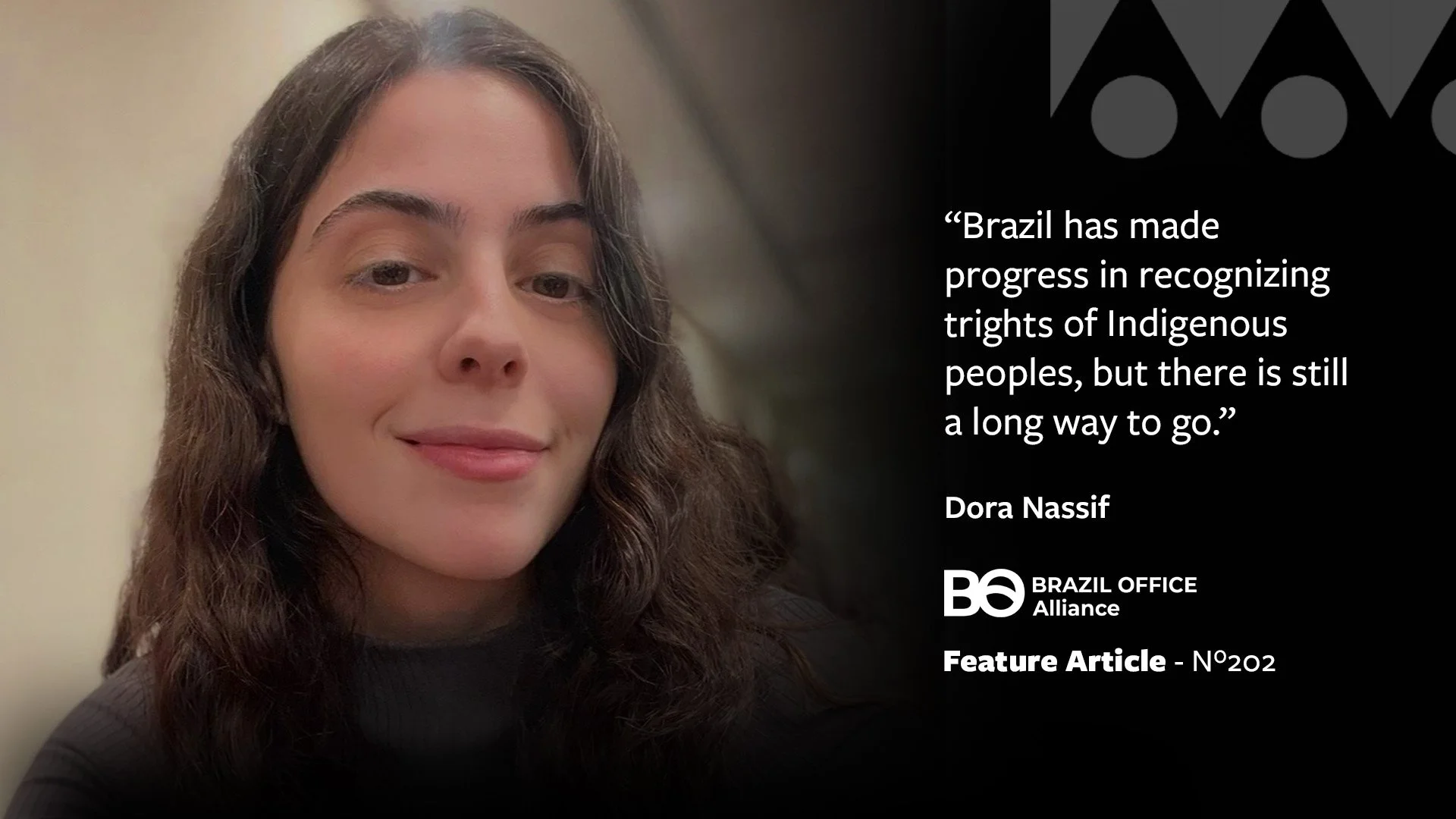
By Dora Nassif*
In Brazil, there is a recurring misconception that the 1988 Constitution created the rights of Indigenous peoples. This is not true. These rights were not born there; they already existed long before. The Constitution did not create these rights; it only recognized them.
This is because Indigenous peoples are original peoples. In simple terms, this means that their relationship with the land does not depend on authorization from the State. They were already there before the formation of the Brazilian State itself. Many of these lands were taken throughout history. What the law does, therefore, is recognize a prior right, not grant it.
This recognition does not exist only in Brazilian law. It also appears in international human rights instruments, which affirm the obligation of States to protect Indigenous peoples, their territories, and their ways of life. However, just as with the Constitution itself, these instruments, despite important advances, including within the Judiciary, prove insufficient to guarantee, in practice, the plurality and autonomy of these peoples.
But there is an important difference between recognizing a right and guaranteeing it in practice.
Today, one of the biggest problems faced by Indigenous peoples in Brazil is not the total absence of norms that recognize their rights. This recognition exists, albeit partially. The problem is that it coexists with constant attempts at restriction and, mainly, with a lack of effectiveness. The demarcation of lands, which should ensure the physical and cultural survival of these peoples, often does not happen. And, when it does, it is not accompanied by effective protection.
In practice, this means that communities remain exposed to violence, the invasion of their territories, and environmental degradation, even when there are judicial decisions or formal recognition of their rights. In many cases, companies responsible for environmental damage are not held accountable in a manner proportional to the severity of the impacts caused. The collapse of the Mariana dam, operated by Samarco, controlled by Vale and BHP, which contaminated the Rio Doce, is an emblematic example of this imbalance.
In recent years, this scenario has worsened with the debate surrounding a thesis called the "temporal framework." In simplified terms, this idea argues that Indigenous peoples only have rights to the lands they occupied in 1988, the year the Constitution was promulgated.
The problem is that this thesis ignores a basic fact: many peoples were expelled from their lands throughout history, especially during the military dictatorship and other periods of violence. Demanding that they be physically present in 1988 is, in practice, legitimizing these expulsions.
Even after important decisions by the Brazilian Supreme Court on the subject, the debate continues in the National Congress, which is trying to advance measures that could further restrict these rights.
But talking about Indigenous rights is not just talking about norms or judicial decisions. It's talking about people, histories, and realities that are very different from each other.
Indigenous peoples do not exist as a single entity. Brazil is home to hundreds of peoples, with distinct cultures, languages, and forms of organization. There are, however, common struggles, especially for land, the environment, and survival, but each people faces specific forms of violence in different contexts.
Furthermore, the very form of resistance changes over time. Different generations of Indigenous peoples have resisted in diverse ways, according to the historical circumstances they faced. In 1500, resistance took one form. During the military dictatorship, another. Today, in a digital and technological world, it expresses itself in new ways.
This does not mean that one form of resistance is more legitimate than another. All were necessary responses to the challenges of their time. Resistance accompanies the changes in the world, the threats, and the forms of violence, and it is precisely this capacity to transform without ceasing to exist that sustains the continuity of these peoples.
For some, this violence manifests itself through forced displacement. The Tuxá people, for example, were removed from their traditional territory with the construction of the Itaparica dam on the São Francisco River, being forced to relocate due to the flooding of their lands. This was not a choice, but an imposition that profoundly compromised their way of life.
For others, violence comes in the form of environmental disasters. The Krenak people had their river, the Watu, the Doce River, in Minas Gerais, contaminated by the collapse of the Mariana dam. This is not just pollution. It is the death of a river that is sacred, that organizes the life, memory, and spirituality of that people. As Ailton Krenak says, the river is not a resource, it is a relative, it is a grandfather.
In other cases, the violence is direct and brutal. Pataxó communities have been the target of armed attacks, arson, and forced evictions. These are not isolated episodes, but repeated practices that reveal a dynamic of persecution and attempted extermination against those who insist on remaining in their own territory.
These examples show that this is not a one-off problem. It is a structural failure.
At the same time, Indigenous peoples offer fundamental perspectives on other ways of relating to the land, time, and the very idea of development. As Ailton Krenak reminds us in Ideas to Postpone the End of the World, perhaps it is precisely the dominant logic, which separates humanity and nature, that has brought us to the current crisis.
There is even evidence that the Amazon Rainforest itself is not just a natural space, but also the result of centuries of Indigenous management. This reveals a capacity not only for survival, but for building complex, sustainable systems that are deeply integrated into life. In other words, Indigenous peoples not only inhabit the forest, they helped shape it and continue to be, to a large extent, responsible for maintaining the ecosystems that still sustain life on the planet.
Perhaps the biggest mistake is treating Indigenous rights as a matter of the past, or as an issue restricted to a homogeneous group that doesn't even exist. In fact, they concern the present and future of all society.
Brazil has made progress in recognizing these rights, but there is still a long way to go. The challenge now is to make them a reality.
*Dora Nassif is a lawyer, holds a master's degree in Human Rights, and is a doctoral candidate in Legal and Political Sciences at the Universidad Pablo de Olavide in Seville.
