
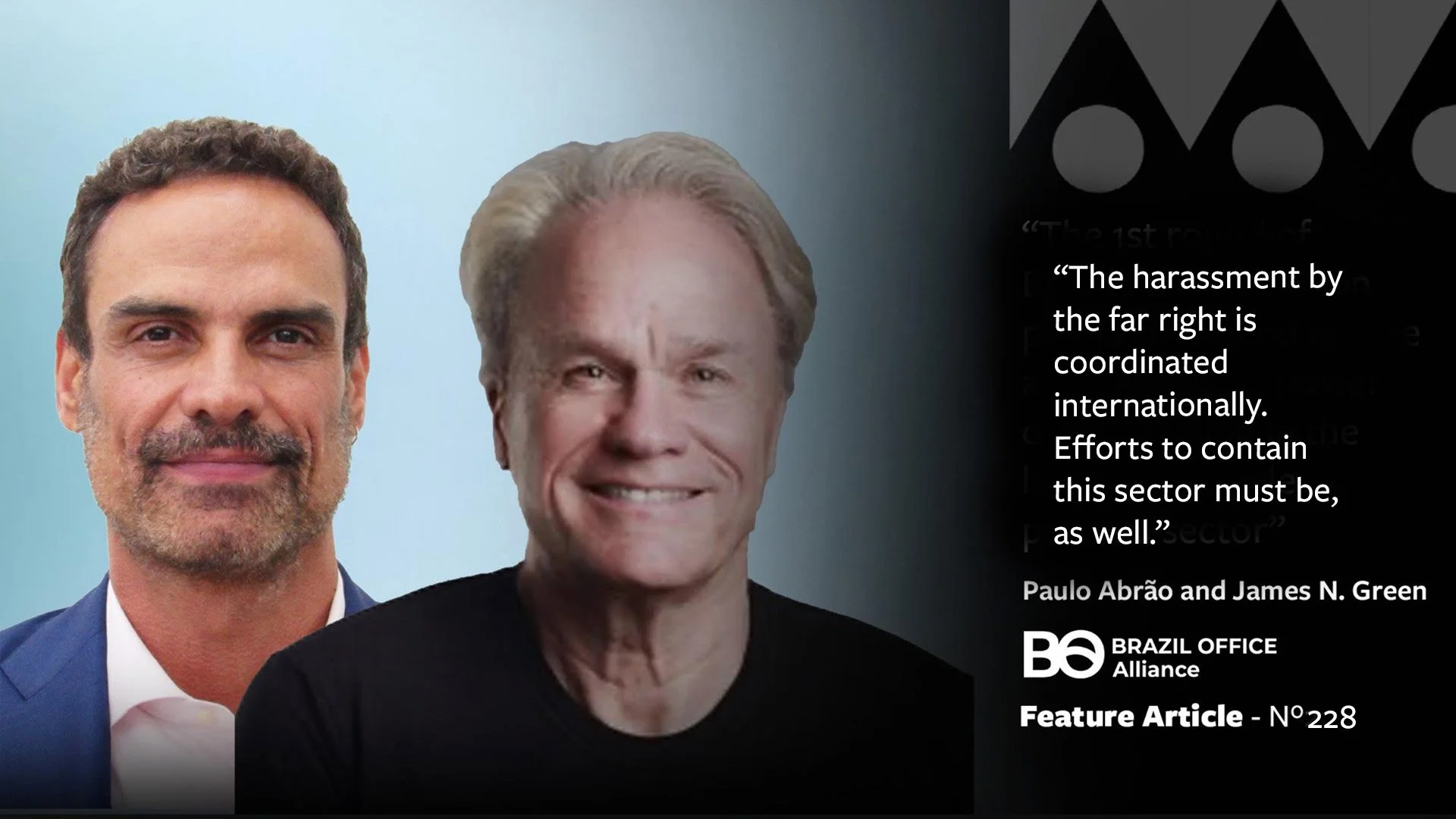
By Paulo Abrão* and James N. Green**
Brazil's 2026 presidential election has concluded, but the risks to democracy remain. Lula’s victory at the ballot box removes the far right from presidential power for at least four years. Yet it must be acknowledged that this radical political faction remains committed to destabilizing institutions and threatening democracy. This can occur through the positions of power they have secured, such as in the Senate, or via illicit maneuvers, as seen in Flávio Bolsonaro’s flight to Miami, from where further hostile actions against the newly elected government are likely to originate.
Lula’s victory is indisputable. The Superior Electoral Court (TSE) validated it, and its president is one of two Supreme Court justices whom Jair Bolsonaro himself appointed. For Bolsonaristas, Justice Kássio Nunes Marques should be beyond reproach. However, as head of the body that oversees elections, he certified the results. Another Supreme Court justice appointed by Jair Bolsonaro who also sits on the TSE is André Mendonça. He, too, raised no objections to the vote’s legitimate outcome. Consequently, no legal grounds exist to challenge Lula’s victory, even from justices aligned with Bolsonarism.
Furthermore, no domestic or international observers present during the election raised substantive questions about the contest's integrity. Finally, the Liberal Party (PL)—s to which Flávio Bolsonaro belongs—issued a statement acknowledging the defeat, effectively leading the far-right candidate himself to concede the result's legitimacy. This should have been enough for Brazil to move forward and heal the wounds inflicted by the failed coup attempt that followed the last presidential election (2022). A defeated Jair Bolsonaro took part in a plot that envisioned seizing the seats of the three branches of government and even the assassination of political leaders and justices, as acknowledged by certain military commanders, all of whom are now in prison.
Yet, that is not what followed. After Lula’s victory and despite clear evidence that it was a fair and clean win, the far right spent the subsequent week engaging in a renewed campaign for a coup. It was no longer orchestrated from within Brazilian palaces or military barracks, but from abroad, more specifically, from the United States, where the most radical members of the Brazilian far right have gathered.
With backing from Donald Trump and Marco Rubio, the United States is supporting baseless challenges to Lula’s victory. This U.S. stance contrasts sharply with dozens of other nations, including Latin American neighbors and European powers, that promptly congratulated Lula on his legitimate win once the results were announced.
The White House's choice to foster instability is not entirely surprising. After all, it comes from an administration that casts unfounded doubt on its own electoral process and employs, within the United States, the very same strategies to destabilize democracy that it now seeks to export to Brazil.
Now, the U.S. Congress must confront these strategies aimed at destabilizing democracy in Brazil. Academics, labor leaders, media figures, and activists committed to defending democracy worldwide should play a similar role. The harassment by the far right is coordinated internationally. Efforts to contain this sector must be, as well.
*Paulo Abrão is the Executive Director of the WBO (Washington Brazil Office). He formerly served as Brazil’s National Secretary of Justice. He also served as Executive Secretary of the Inter-American Commission on Human Rights of the Organization of American States and as Director of the Mercosur Institute of Human Rights. He was a visiting scholar at the Watson Institute for International and Public Affairs at Brown University.
**James N. Green is Professor Emeritus of Brazilian History and Culture at Brown University, the author or co-editor of twelve books on Brazil, and Chair of the Board of Directors of the WBO (Washington Brazil Office).
