
The Brazilian Congress and the Selective “Bukele-ization” of Public Security
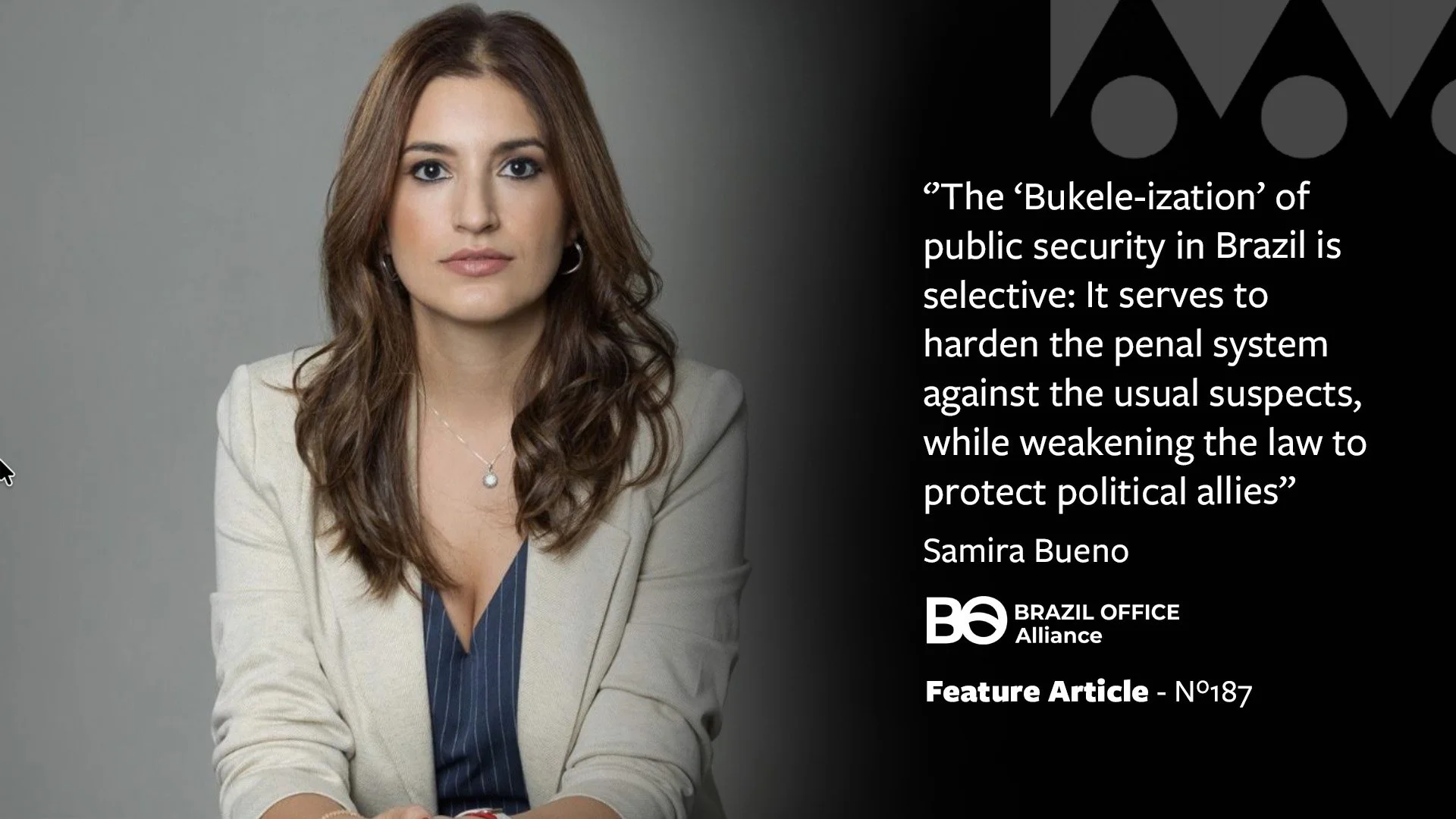
By Samira Bueno*
Fear of crime and violence has made public security the main concern of the Brazilian population, according to recent research. This fear is not unfounded. A country that has historically lived with high rates of homicide and domestic violence has, in the last decade, begun to face a new phenomenon: the national spread of criminal organizations associated with drug trafficking, whose origins are based in São Paulo and Rio de Janeiro. Added to this is an epidemic of cell phone thefts, online scams, and increasingly organized and violent property crimes.
This expansion of organized crime has profoundly transformed the dynamics of Brazilian cities. What were once local groups and disorganized gangs have given way to organizations that have become professionalized in the world of crime and have begun to operate in partnership with Comando Vermelho and PCC, two of the largest criminal organizations—or have been directly co-opted by them. Organized crime has ceased to be a localized problem and now has a national structure with direct impacts on daily life. In the Amazon, cities crisscrossed by rivers and forests are strategic for the flow of drugs towards Europe. In urban areas, community leaders have their voices silenced by the violent imposition of organized crime. In the Northeast, there are constant reports of families who financed their homes through the government-sponsored Minha Casa Minha Vida (My house, my life) program and were subsequently expelled by armed drug traffickers. Territorial control has ceased to be the exception and has become the rule in many poor and working-class neighborhoods of the country.
It is in this context that the Congress has placed public security at the center of its agenda for 2025. It is a crucial issue. The problem is how it has been addressed. Instead of structural responses based on evidence and governance, a significant part of Congress—especially sectors of the center and the far right—has instrumentalized the population's fear to produce an agenda of increased criminal penalties that is efficient in mobilizing indignation and votes, but ineffective in reducing violence.
Two projects illustrate this movement well: the so-called Anti-Gang Bill and the substitute for the Public Security constitutional cmendment, both originating in the federal government but profoundly altered in Congress.
The Anti-Gang Bill, in its original version, is part of a correct diagnosis: confronting gangs requires financial intelligence, sophisticated investigation, cooperation between agencies, and modernization of investigative tools. However, during its rapid passage through the Chamber of Deputies, the project was distorted. There was a weakening of the Federal Police, an excessive expansion of criminal penalties, and persistence of the reliance on prisons, diverting the focus from what truly weakens organized crime. The Senate managed, in part, to correct these excesses, but the project returns to the Chamber at risk of further setbacks.
Something similar is happening with the Public Security constitutional amendment. The government's original proposal sought to constitutionalize the Unified Public Security System (SUSP) to strengthen federal governance and coordination between the federal government, states, and municipalities. However, the substitute bill approved in the Chamber of Deputies converted this systemic logic into an architecture centered on task forces, special operations, and constitutionally sanctioned penal support.
The text proposes the including in the constitution the Differentiated Disciplinary Regime (RDD), a broad restriction on reducing criminal penalties, the creation of specialized incarceration for members of gangs, and even the possibility of reducing the age of criminal responsibility through a plebiscite. All of this is presented as a response to organized crime, but it somewhat aligns with what, in practice, could weaken gangs sin the medium and long term.
By transforming specific measures into constitutional mandates, Congress risks paralyzing criminal policy, reducing the capacity for future correction, and deepening a logic of prolonged incarceration that, historically, fuels the very gangs it intends to combat. It is no coincidence that the PCC and Comando Vermelho emerged within prisons. Nor is it irrelevant that their main leaders have been imprisoned for decades—without this preventing their territorial and economic expansion.
The paradox becomes even more evident when one observes that, amidst this discourse about punishment, the Chamber of Deputies approved, in the dead of night, the so-called Sentencing Bill, which reduces the time required for sentence progression in certain crimes. The initiative was designed to benefit those convicted for the coup attempts of January 8, 2023—including former president Jair Bolsonaro, now imprisoned—but its effects also extend to common crimes.
Brazil is thus experiencing a blatant contradiction. On one hand, congressmen inspired by Salvadoran President Nayib Bukele’s model of public security advocate for longer incarcerations, with fewer rights and at increasingly younger ages, for those who have always been the main clients of the criminal justice system: young, poor, and marginalized Black people. On the other hand, these same parliamentarians are mobilizing to reduce sentences and facilitate the release from prison of coup plotters linked to the political elites.
The “Bukele-ization” of public security in Brazil is selective. It serves to harden the penal system against the usual suspects, while weakening the law to protect political allies. The saga will continue in 2026 – an election and World Cup year – but one thing is already clear: for influential segments of the Congress, incarcerating more and for longer periods is great – as long as it is Black, poor, and marginalized people who fill the prison pavilions.
*Samira Bueno is the executive director of the Brazilian Forum on Public Security and coordinator of the professional master's program in management and public policy at IDP.
