
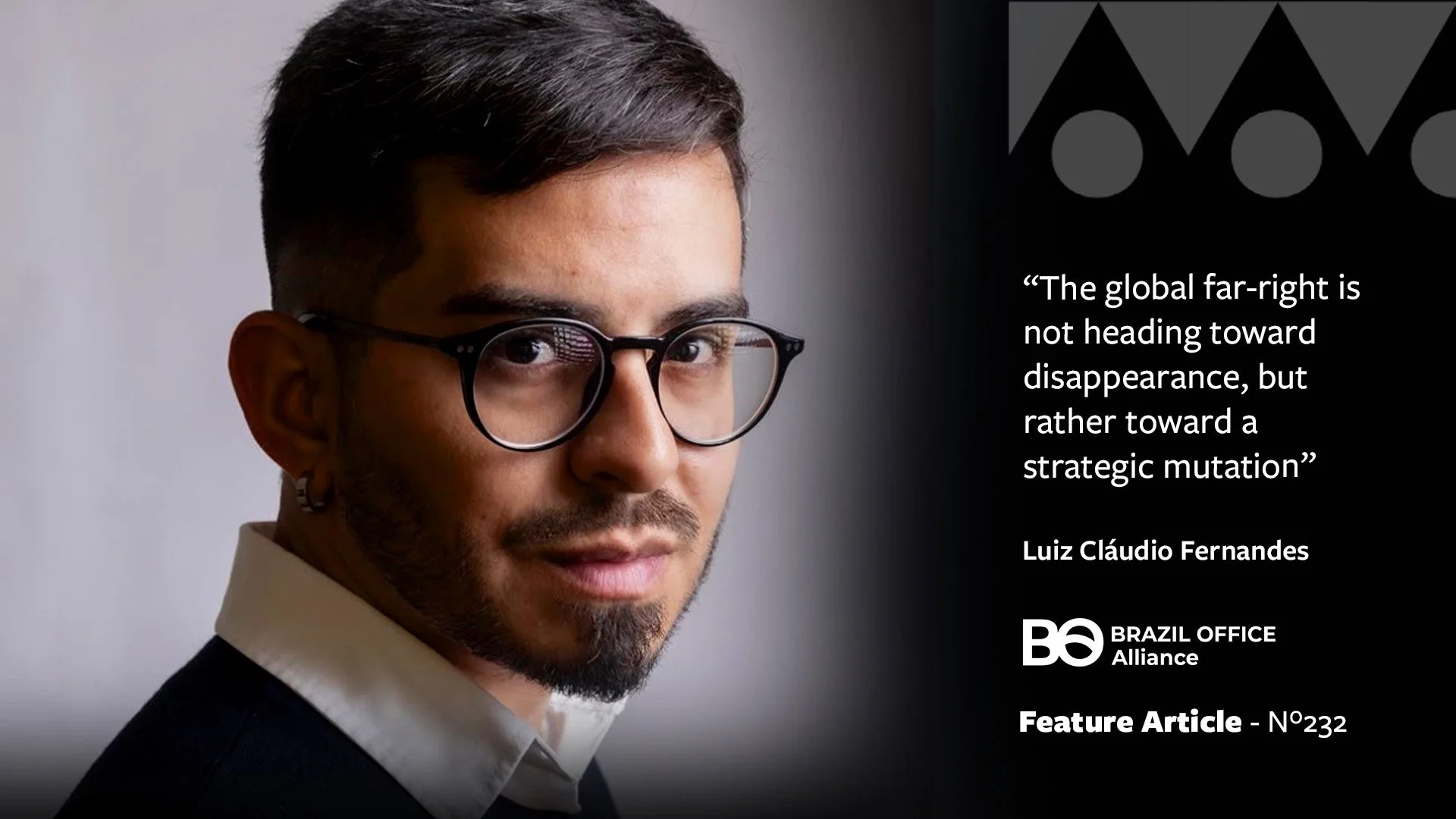
By Luiz Cláudio Fernandes*
Over the last decade, the far-right has moved from being a mere footnote in democratic systems to occupying the center of gravity in global politics. Unlike the classical fascism of the 1930s—characterized by violent ruptures and tanks in the streets—this contemporary phenomenon (the "fourth wave" of the radical right since World War II) has learned to corrode democracies from within. It does so by leveraging laws, elections, institutions, religion, and the entire digital ecosystem. Yet, as we look at the geopolitical landscape for 2026–2027, the movement reveals a dual nature: while it shows signs of electoral fatigue in key arenas, it is simultaneously consolidating cultural, economic, and parliamentary structures that ensure its survival for years to come.
On a global scale, the far right does not operate as a monolithic bloc, but as an archipelago connected by shared methods: fabricating internal and external enemies, cultivating moral panic, denying the importance of institutions, and using disinformation as a tool of power. It is no coincidence that disinformation ranks among the primary contemporary global risks, fueled by algorithms, social media, and artificial intelligence.
Even though Donald Trump faced a significant setback in the November 2026 midterm legislative elections with Democrats regaining substantial ground in the House, the "Trumpian" style of politics remains a blueprint for many extremist figures, albeit with necessary local adaptations.
In Europe, the far-right has firmly established itself as either a governing force or a power capable of exercising a veto. Italian Prime Minister Giorgia Meloni embodies a strategy of "institutionalization." She moderates her tone in international forums to ensure economic governability while pushing forward identity-based agendas and state control at home.
In Latin America, the pendulum swings in different directions. Javier Milei’s Argentina serves as a radical laboratory for anarcho-capitalism and alignment with Washington. Chile faces the potential rise of José Antonio Kast to the presidency in 2026 with an agenda centered on hardline security and immigration restrictions. In Brazil, the defeat of Flávio Bolsonaro—alongside Lula's reelection—has put a brake on the immediate return of Bolsonarism to the presidential palace. Even so, the ultra-conservative camp has expanded its strength within the National Congress and the Senate, retaining the power to block institutional action and maintaining a grassroots presence across municipalities.
Yet, to understand why these leaders continue to resonate, even following crises of governance, one must look beyond the ballot box. As I analyze in my book Global Chaos: The Far Right Worldwide and Its Brazilian Face, the advance of extremism is inseparable from a structural crisis within contemporary capitalism. This crisis has brought to the surface inequalities, precarious living conditions, and uncertainty, creating a climate of social and cultural instability that favors extremist rhetoric that exploits people’s fears and resentments by constructing both internal and external enemies. In this narrative, the "enemies" or the "culprits" are never big capital or those who have amassed vast fortunes. Instead, the convenient scapegoats are the beneficiaries of social programs (such as Brazil’s Bolsa Família), immigrants, the press, judicial institutions, and social minorities in general.
This domestic turbulence mirrors an even deeper rupture on the international stage. The geopolitical architecture constructed after the Second World War, which laid the foundation for multilateralism and gave rise to the United Nations, has collapsed, and no new order has yet emerged. In its place, a phase of open conflict between major powers has emerged, characterized by multipolarity and the "law of the strongest." It is precisely within this vacuum of global stability where coups, crimes, and assaults on democracy are frequently downplayed or ignored that the far right finds an unencumbered path to advance its ideologies without restraint.
Ultimately, this entire movement is fueled by an unprecedented concentration of wealth. International reports have already identified the emergence of a global "new aristocracy," in which billionaires and tech conglomerates fund media ecosystems and digital platforms that profit directly from polarization and the commodification of hatred. Thus, the cycle is complete: economic crisis breeds popular resentment, geopolitical disorder ensures institutional impunity, and the pinnacle of the financial pyramid bankrolls the digital machinery that keeps society in permanent conflict.
Given this, I look toward the horizon of the coming years. The global far-right is not heading toward disappearance, but rather toward a strategic mutation based on three main axes:
Institutionalization and the "coup from within": Isolated electoral defeats do not signify the end of the movement. The far right is increasingly prioritizing control of parliaments, local councils, courts, and regulatory bodies. With robust legislative majorities, the goal shifts from merely winning the executive branch to rewriting constitutional rules, hollowing out checks and balances, and making the state porous to corporate and fundamentalist interests.
The culture war and the contest for the youth: The far-right has grasped that politics is a consequence of culture. In the coming years, heavy investment in occupying religious spaces, especially within conservative evangelical segments, and in producing digital content aimed at young people will remain central. The challenge for this camp will be to reconcile the rhetoric of a "minimal state" with the concrete demands of a youth suffering from a lack of social rights and economic prospects.
The internationalization of networks and Big Tech: The boundary between domestic politics and geopolitics has become irrelevant to the radical right. Coordination among national leaders, ultra-conservative think tanks, and tech-sector billionaires creates a transnational shield against local legislation aimed at digital regulation and the fight against disinformation.
The future of democracies will therefore depend on the democratic camp's ability to go beyond mere electoral containment. As long as traditional politics limits itself to defending institutions in the abstract without offering concrete, material responses to inequality and the precarious nature of life, the far right will continue to find fertile ground to turn social disenchantment into a project for authoritarian power.
*Luiz Cláudio Fernandes is a university professor and journalist, currently a doctoral candidate in Communication and Politics (PPGCOM/UFPA). He is the author of the book Global Chaos: The Far Right Worldwide and Its Brazilian Face. He is also a member of the National Network to Combat Disinformation (RNCD).
