
Trump 2.0: Definitive Crisis or Opportunity to Rebuild Democracy
By Rafael R. Ioris*
The American political system has shown strong signs of dysfunction in recent years. Once widely respected, majority elections have become a focus of dispute and distrust. The national legislature faces recurring decisional paralysis, often resulting in the paralysis of public services as well. The occupant of the executive branch, in turn, is increasingly accused of governing only for his captive electorate, and judicial decisions are increasingly seen as open expressions of particular political positions.
More broadly, society in general is becoming increasingly polarized by almost watertight ideological lines, where one side seems no longer to recognize the legitimacy of opposing positions. Given such a complex scenario, the return to the presidency of such a divisive figure as Donald Trump has generally been understood as a factor exacerbating an already discouraging situation for the functioning – perhaps even the very survival – of institutions and even the democratic culture in the United States.
Considering what his administration has done during the first year of this second term, there are certainly strong reasons for concern. After all, clearly and in a coordinated manner, from its inception, the new Trump administration has intensified a highly polarizing rhetoric, where the opposition is treated as an internal enemy, and government agencies are staffed by strictly aligned cronies, while professional bureaucrats are persecuted and dismissed.
Similarly, power structures are controlled in a way that guarantees tax breaks and legislative reforms that almost exclusively favor allied politicians and major financiers, while marginalized sectors are morally attacked and have their state aid programs suspended. Finally, anti-intellectualism becomes commonplace, and non-aligned government agendas – such as science, education, the environment, and racial and gender inclusion – are rejected, and programs or funds associated with these agendas are canceled.
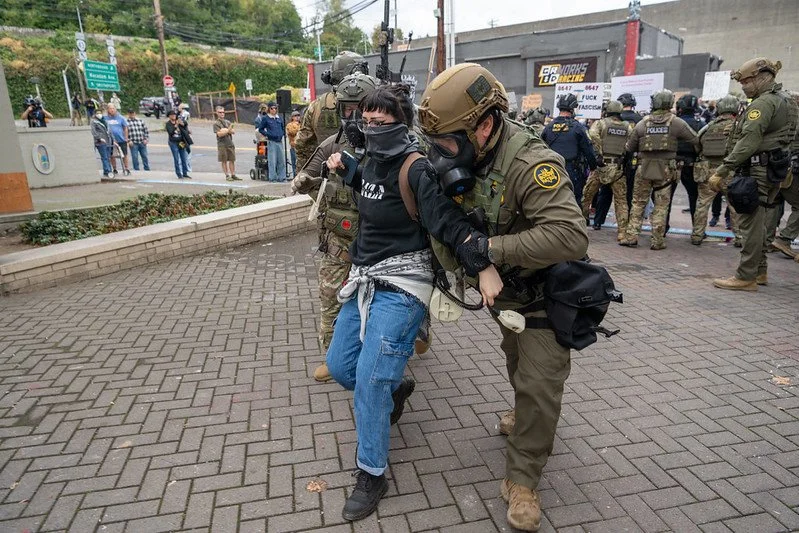
In this context of a growing narrowing of horizons and even a shortening of democratic logic, the figure of the immigrant, especially those of Latin American origins, clearly reflects the centralization of power and the growing climate of political and ideological persecution in the country. But, if the vilification of immigrants cross U.S. borders to enter the United States was a highly effective campaign theme for Trump as early as 2016, today mass deportation has taken on even greater relevance, with immigration police (ICE) acting in a more coordinated manner on the streets across the country.
Even if there is still support for greater border control and even the deportation of undocumented immigrants, the way ICE operates – generally brutal, often illegal, and, so far, with almost total impunity – may perhaps transform what has been one of the current government's mainstays into the missing opportunity to organize a more coordinated resistance to the ongoing process of power concentration and personality cult. After all, if since the beginning of the current administration, democratic forces of all kinds have had great difficulty finding a structuring axis capable of uniting their diverse voices, the tragic events of recent days in Minnesota seem to have the potential to reverse this situation.
In concrete terms, the unjustifiable deaths at the hands of ICE agents of Renee Good and Alex Pettri, two middle-class white people living in the same city and within a two-week period, clearly and concretely demonstrate the gravity that was lacking to mobilize even voters still hesitant about the issue of police brutality recurrently inflicted on less privileged social groups. This is reinforced by the fact that both deaths were filmed by numerous cell phones for anyone willing to see the truth of the facts.
Tragically, beyond the pain already caused by these and other deaths, as well as by the recurring violations of the rights of immigrants and even U.S. citizens, nothing indicates that similar events will not occur again, especially amidst what is hoped will be a broad movement in defense of human and civil rights in the country. It certainly will not be an easy task, and it will not work if it depends solely on the institutional leadership of the opposition.
The government seems to be feeling the pressure, even beginning to somewhat mitigate its aggressiveness. But lasting change will have to involve, broadly and continuously, wide sectors of society, especially the most attacked and suffering residents of the country. If this does, in fact, happen, we can finally say that Trump's return will have meant not only the definitive establishment of the American political system based on an autocracy, but perhaps the reconstruction of the political system.
*Rafael R. Ioris is a professor at the University of Denver and a Research Associate at the WBO.
