
Why does the Brazilian Right Want to Weaken the Federal Police?
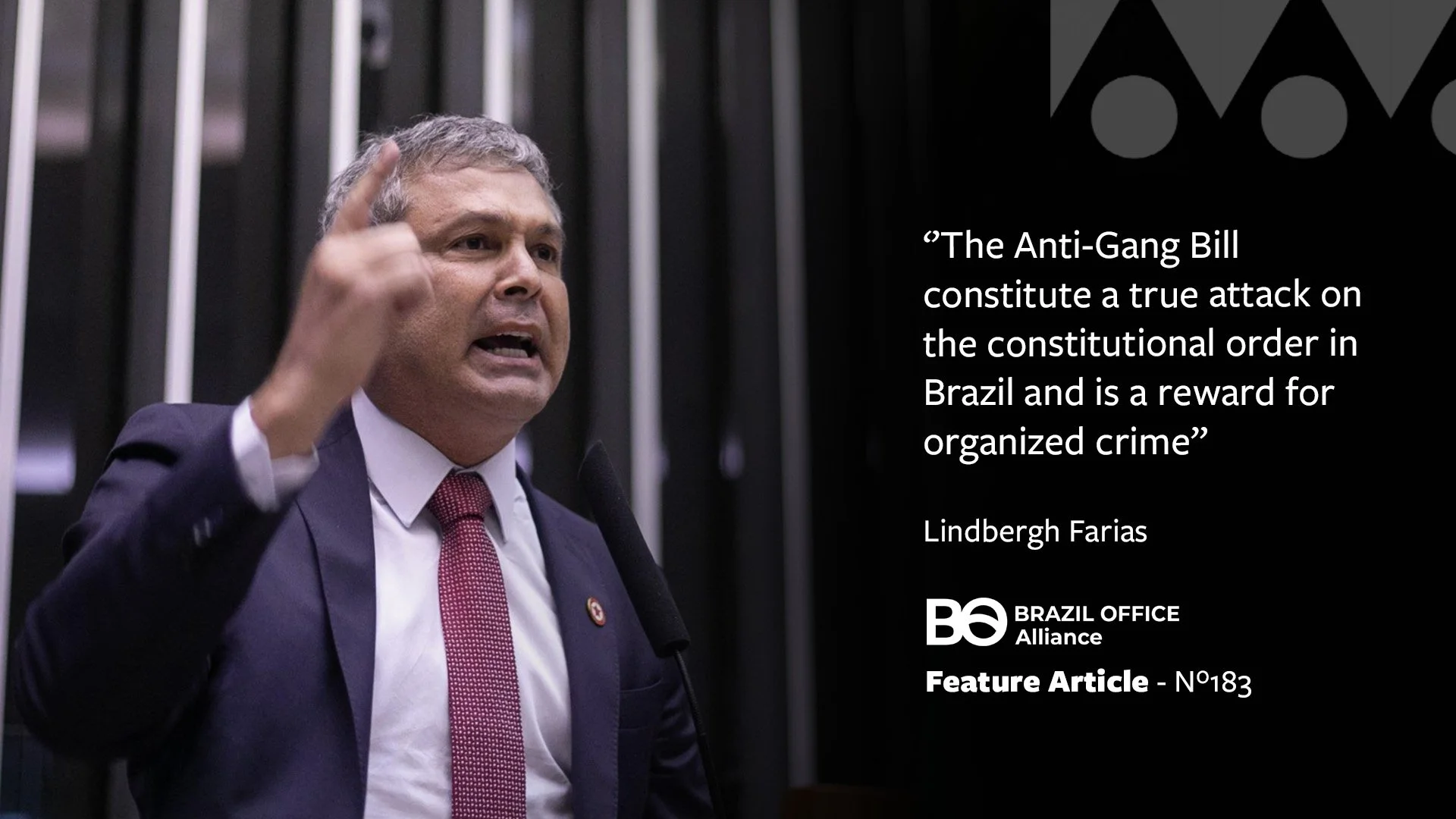
By Lindbergh Farias*
The opinions of Guilherme Derrite, the Secretary of Security of São Paulo and a congressman, who supports Bolsonaro, and bill Bill 5.582/2025, known as the Anti-Gang Bill, constitute a true attack on the constitutional order in Brazil and is a reward for organized crime.
The sixth version of what has come to be known as "Frankenstein" substitute language for the Anti-Gang Bill, which was approved on November 18th by the Chamber of Deputies, deepens normative disorganization and maintains serious structural flaws, especially by withdrawing resources from the Federal Police, weakening the national coordination body overseeing issues related to crime, and contradicting the spirit of the Constitutional Amendment Proposal on Public Security sent by the Lula government to the National Congress.
Instead of strengthening the Federal Police, the text promoted a budgetary fragmentation in relation to funds that compromises the efficiency in confronting criminal organizations operating across state lines. In that regard it is an affront to the Anti-Faction Bill sent by the Lula government to Congress. The substitute bill also dismantled the policy of draining the financial resources of criminal organizations by eliminating the special injunctions foreseen in the original bill, replacing them with existing instruments and creating the fiction of "autonomous civil action," which only adds delays, legal uncertainty, and fragmentation to asset recovery procedures.
The approved bill brought serious pitfalls: it removed the federal government's control over the sale and destruction of seized assets, striking at the heart of the policy of taking control of the financial resources of criminal organizations. Instead of strengthening the State, it weakens the Federal Police and makes it more difficult to force the forfeiting of organized crime’s assets. The creation of an autonomous civil action for the forfeiture of assets is a legal farce that will delay confiscation and reduce the Federal Police's resources in the fight against crime.
The Bolsonaro-supporting congressman attacked the backbone of the Anti-Faction Bill – precisely the ability to quickly block illicit resources and strike at the financial heart of criminal groups.
Furthermore, the far-right congressman invented categories without legal basis in an attempt to erase the rigorous terminology of "criminal gang" introduced in the original text of the federal government.
This type of conceptual improvisation weakens criminal policy, confuses legal professionals, and masks the real objective: to disfigure the Executive's technical and consistent proposal, replacing it with a jumble of empty concepts and contradictory provisions. In practice, this confusion creates legal chaos that will only favor the lawyers of criminal gangs.
Why didn't Derrite propose changes to the Law on Criminal Organizations, the Penal Code, and the Code of Criminal Procedure, creating a fourth legal norm, which he called the "Legal Framework for Combating Organized Crime"?
There's a lot up in the air. The far-right governors have once again acted against the logic of the Security Amendment, which advocates for the integration and strengthening of police forces. They defended the vote on the Anti-Faction Bill, arguing that it would restore the logic of protectionism, harming the autonomy of the Federal Police and preventing it from acting fully against organized crime.
To understand the scenario, it's important to remember that this offensive is not accidental: Operation Hidden Carbon, carried out by the Federal Police, which targeted laundering and adulteration of fuel networks linked to large economic and political groups, raised alarm bells among governors and businessmen under investigation. If Derrite's proposal had been in effect, more than R$ 1 billion from organized crime would not have been confiscated, nor would the fuel from four ships seized by the Federal Revenue Service in Rio de Janeiro.
The most emblematic example is that of Governor Cláudio Castro of Rio de Janeiro, who, fearful of the repercussions of Operation Hidden Carbon, revealed possible connections between his government, the company Refit, and fuel adulteration schemes associated with criminal factions.
There is also an open inquiry by Minister Alexandre de Moraes of the Brazilian Supreme Federal Court, seeking to investigate the relationships between organized crime and public officials, which explains the discomfort and haste in weakening the Anti-Faction Bill in the Chamber of Deputies, as indeed occurred. The firm and autonomous action of the Federal Police bothers those who fear that the truth will come to light.
The attempt to subordinate the Federal Police to governors, a practice that had been occurring for 100 years, was defeated by popular mobilization. But the new movement shows that there are powerful sectors trying to retaliate against the firm action of the Federal Police, especially in investigations that touch on the links between political power, gangs, and militias.
The Federal Government refused to negotiate any measures that would defund and weaken the Federal Police – the main instrument in the fight against criminal organizations and corruption – nor any that would hinder the forfeiture of assets from organized crime. But the Chamber of Deputies approved this setback. Public security is impossible without a strong, autonomous Federal Police force, free from political constraints.
Recent figures demonstrate the effectiveness of the Lula government's strategy. Since 2023, integrated security actions, with the Federal Police at the forefront, have seized R$ 19.8 billion from criminals – the largest financial loss ever imposed on crime in the country. The number of Federal Police operations has increased by 80% since 2022. It is precisely this success that is causing concern.
The Anti-Faction Bill, in its original text (plus the Public Security Amendment), sought to sustain and expand these advances, financially crippling the gangs and modernizing the integration of security forces. However, the substitute bill approved by the Chamber of Deputies goes in the opposite direction. It is everyone's duty to vehemently reject this setback and reinstate the original text from the Lula government in the Federal Senate.
*Lindbergh Farias is a federal deputy (RJ) and leader of the Workers' Party caucus in the Chamber of Deputies.
