
Civil Society Delegation Visits Washington to Oppose U.S. Interference and Defend Brazilian Sovereignty
Press release
21 July 2026
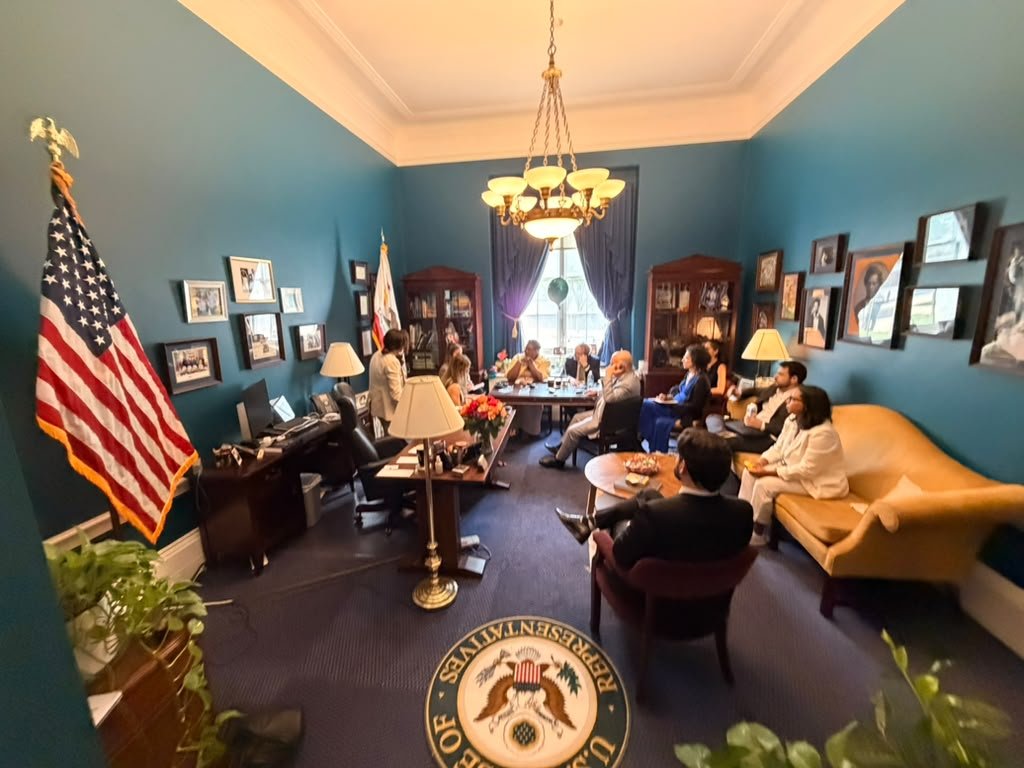
A delegation comprising representatives from 15 Brazilian civil society organizations is carrying out an intensive schedule of meetings from July 20 to 24 in Washington and New York. They are meeting with diplomats from various countries, U.S. senators and representatives (along with their legislative staff), labor leaders, journalists, academics, and local civil society leaders to express their views on issues such as democracy, sovereignty, and the regulation of Big Tech.
These high-level meetings are taking place against the backdrop of growing interference by the current U.S. administration in Brazil's presidential race this year. Delegation members have been warning their U.S. counterparts about the harmful effects of this undue interference, which is occurring largely at the behest and pressure of Brazilian far-right politicians and activists based in the United States.
Countering the narrative that invites or encourages foreign intervention, the group conveys a unified message about the reliability of Brazil's electoral system and the importance of the United States refraining from interfering in the October election. Delegation members are also urging U.S. lawmakers to press their own government to duly recognize the winner of the Brazilian presidential race—whoever that may be—as soon as the vote count concludes, in accordance with the best practices of international diplomacy and respect for the principle of non-interference among sovereign states.
Meetings
Over the course of three days, the group is meeting with diplomats from the Brazilian Embassy in Washington and representatives from two strategic offices of the Organization of American States (OAS)—the Department for Effective Public Management (specifically the section on strengthening democracy) and the Department of Electoral Cooperation and Observation—as well as Brazil’s ambassador to the OAS and members of the Inter-American Commission on Human Rights. In the U.S. Congress, meetings were held with Democratic Representatives Mark Pocan, Joaquin Castro, Chuy García, and Jonathan Jackson, as well as with the congressional staff of Democratic Representatives Jim McGovern, Sydney Kamlager-Dove, Tim Kaine, and Peter Welsh, and a Republican lawmaker.
The agenda with local civil society also included meetings with representatives from the AFL-CIO—the largest federation of labor unions in the United States—and public events at the Heinrich Böll Foundation, where issues regarding the impact of digital platforms on democracy and data centers on the environment were discussed, and at the Open Society Foundations, where the agenda addressed the effects of political polarization in Brazil and the role of civil society in elections.
Quotes
Rogério Sottili, representing the Vladimir Herzog Institute in the delegation, highlights "the environment of respect for freedom of expression in Brazil and the importance of defending the solidity and stability of Brazilian democracy," especially during this presidential election cycle. Paulo de Tarso Vannuchi, of the Dom Paulo Evaristo Arns Commission for the Defense of Human Rights, emphasizes "that human rights must be the legitimate benchmark for Brazil's international actions." In contrast, Rogério Studart, of Direitos Já (Rights Now – Forum for Democracy), stresses the importance of "constant, cohesive, and coordinated attention in defense of Brazilian democracy at this delicate moment."
"International solidarity in defense of Brazilian democracy as part of the labor union agenda" was highlighted by CUT representative Antônio de Lisboa Amâncio Vale, while the "prevention of all acts of political violence—especially against women, both within and outside the electoral context"—was underscored by Larissa Correia de Amorim, of the Marielle Franco Institute. Meanwhile, Gabriela Batista Pires Ramos, of the Odara Institute, expressed concern regarding the risk of “rise in hate speech, as well as the intensification of gender- and race-based political violence.” The “necessary control and regulation of social platforms for the strengthening of democracy” was highlighted by André Lucas Fernandes, of the Recife Institute for Research on Law and Technology (IP.rec), who—along with Cynthia Picolo Gonzaga de Azevedo, of LAPIN (Public Policy and Internet Laboratory)—emphasized the importance of “Brazilian legislation being respected by all foreign companies operating within the country, regardless of their origin, capital, or size.”
Fábio Balestro Floriano, of the Futuro Institute, stated that “international cooperation is important and welcome, but unilateral political interference must be denounced and rejected.” Meanwhile, Renata Castro Boulos, representing the Homeless Workers' Movement (MTST), advocated for “the centrality of the agenda of struggles for rights and the role of organized civil society in the international defense of Brazilian democracy and the rights of its citizens.”
Oscar de Souza Fernandes Apinage, a representative of the Articulation of Indigenous Peoples of Brazil (APIB), highlighted “the crucial importance that the outcome of this election holds for the direction of the entire discussion on climate change, the protection of Indigenous peoples, and environmental defense worldwide.”
Ana Paula Barreto, from Libera, emphasized “the importance of forming international solidarity networks to protect women in the face of regressive proposals.” At the same time, Pedro Paulo Bocca, from the Group of Institutes, Foundations, and Companies (GIFE), noted that “the challenges Brazil faces are also present in other countries, reinforcing the importance of cooperation and the strengthening of democracy on a global scale.”
In 2022, a similar delegation helped ensure free and democratic elections at a time when Brazilian democratic institutions were under attack from within. This time, the attacks are coming from the international arena. “The legitimacy of our international initiative lies in the distinction of defending democracy and Brazilian sovereignty rather than attacking them. Upholding and defending the rule of law in challenging situations requires courage,” states Paulo Abrão, Director of the Brazil Office. He concludes: “Civil society has become a structural actor in global governance. Its participation has shifted from being exceptional to becoming an indispensable element for the legitimacy, implementation, and oversight of international rules and principles.”
List of organizations and social movements in the delegation:
Articulation of Indigenous Peoples (APIB), Arns Commission, CUT (Unified Workers' Central), Direitos Já, GIFE (Group of Institutes, Foundations, and Companies), Instituto Futuro, Marielle Franco Institute, Vladimir Herzog Institute, IP.rec (Recife Institute for Research on Law and Technology), LAPIN (Laboratory on Public Policy and the Internet), Homeless Workers' Movement (MTST), Odara (Black Women's Institute), and Plataforma CIPÓ. Supporting local organizations:
4H5H MEDIA, Amazon Watch, BRASA – Brazilian Studies Association, CEPR – Center for Economic and Policy Research, Defend Democracy in Brazil Committee - New York (DDB-NY), Amnesty International USA, Fundación Avina, Heinrich Böll Foundation, Instituto Libera, USNDB – US Network for Democracy in Brazil, WOLA – Washington Office on Latin America, and Brazilian Women’s Group.
