
Voices of the Cerrado and International Bodies Engage in Dialogue on Rights and Climate Justice
28 de maio de 2026
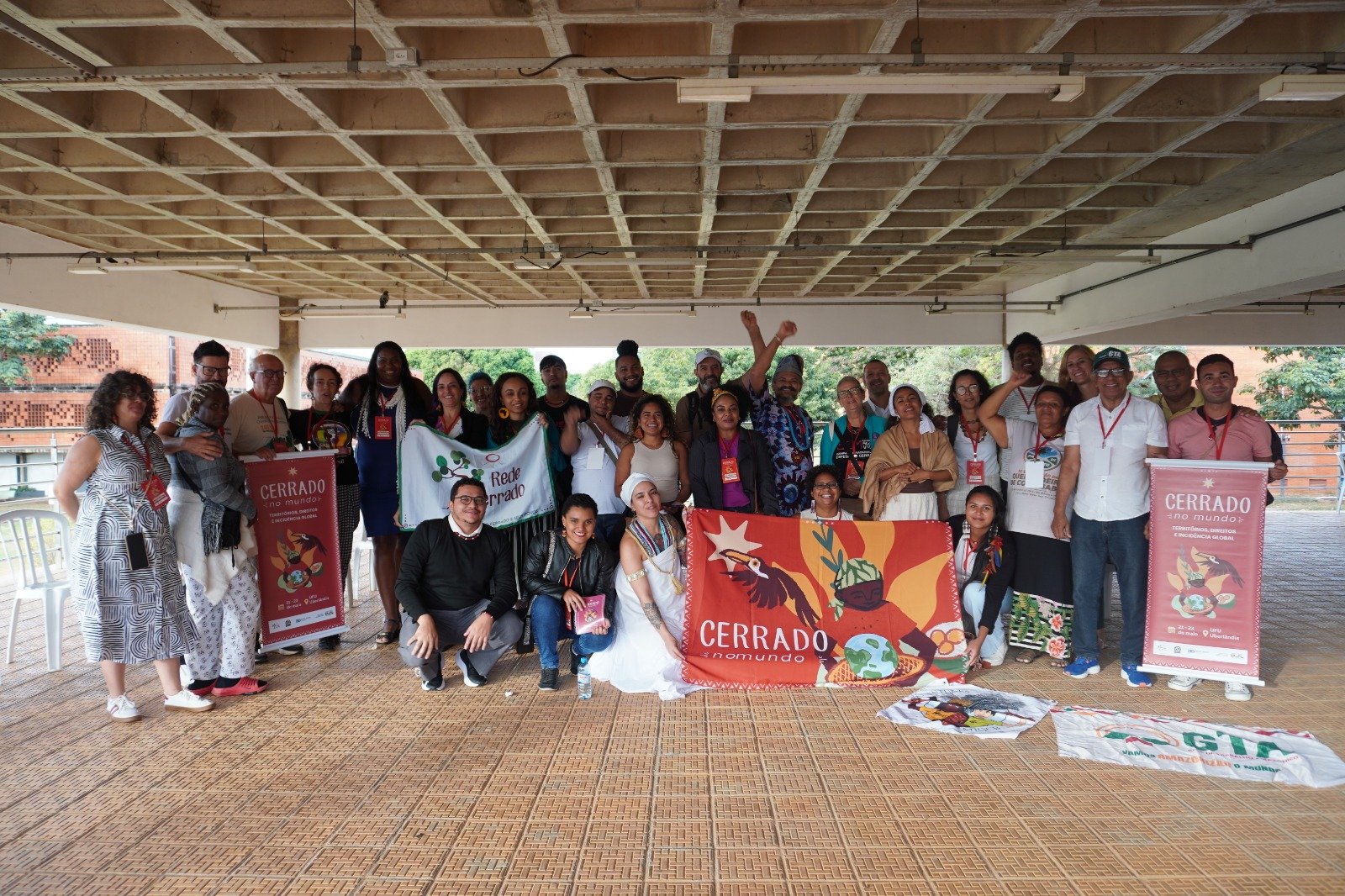
During three days of activities, leaders and organizations from the Cerrado (Brazilian savannah) shared experiences, challenges, and strategies of resistance in dialogue with national and international representatives linked to human rights and climate justice.
The Cerrado continues to be sacrificed by the expansion of commodities aimed at international trade. In 2025, the biome accounted for 55% of all deforested land in Brazil, according to RAD2025 data. In response to this scenario, community leaders, researchers, and decision-makers gathered at the event “Cerrado in the World: Territories, Rights and Voices in Global Advocacy” with the goal of internationalizing the debate on the destruction of the biome and denouncing to the world the socio-environmental impacts of this model of exploitation.
The discussions addressed issues such as climate justice, desertification, territorial rights, protection of inhabitants traditional knowledge, and the right to free, prior, and informed consultation and consent regarding projects and policies that impact territories. Among those participating in the meeting, held from May 21 to 23 in Uberlândia, Minas Gerais, were traditional peoples and communities, Afro-descendant communities from the Cerrado, and international human rights organizations.

Community leaders shared testimonies about contamination by pesticides and heavy metals; environmental and religious racism; territorial violence; the impacts of railways, waterways, mining, and commodity expansion; as well as the loss of languages, cultural practices, and traditional ways of relating to the Cerrado.
For Samara Santos de Oliveira, from Rede Retalho and MOVEN (Black Student Movement of UFV-CRP), the event helped give visibility to the multiple crises faced by the Cerrado while also highlighting the resistance strategies developed by the communities themselves. “Even in such a challenging context, different communities are able to develop their own strategies of resistance and adaptation,” she stated.
This and other statements highlighted the need to strengthen recognition of the Cerrado not only as a strategic biome for climate balance, but also as a territory directly linked to the guarantee of fundamental human rights.
Organizations also affirmed that transforming scattered complaints into structured information is a fundamental step toward increasing the presence of the Cerrado within international human rights mechanisms and strengthening collective advocacy strategies.
The expectation now is that the meeting will help expand the international visibility of complaints that have historically been fragmented or rendered invisible in global debates on climate, development, and human rights, while strengthening direct exchange between communities and international protection mechanisms.
Raissa Felippe, of Tumba Inzo A'na Nzambi Junsara and Associação Vida Inteira, emphasized the importance of ensuring that traditional peoples and communities are heard and take a leading role in debates on the impacts of the destruction of the Cerrado. “This leadership regarding the impacts of the destruction of the Cerrado on our lives must be spoken about by us,” she stressed.

Carolina Martini, from AMEDI (Interactive Environment and Education), one of the organizing entities, highlighted that the debates brought together communities, researchers, and representatives of international organizations around issues fundamental to the future of the biome. According to her, “to look at the Brazilian Cerrado is also to look at the world.”
The meeting represents another step in building collective strategies to strengthen political, social, and international advocacy concerning the Cerrado. As João Bosco, from Rede GTA, stated, “defending the Cerrado means defending food sovereignty, climate justice, territorial rights, and the future of the next generations.”
Javier Palummo, Special Rapporteur of REDESCA/IACHR, participated as part of an academic and promotional visit to the country, during which he addressed the relationship between human rights, climate justice, territorial protection, traditional peoples and communities, environmental democracy, and development models in Latin America and the Caribbean.
On the first day of the event, Diego Soares, professor at the Federal University of Uberlândia (UFU), Gustavo Malacco, from Angá – Cerrado Conservation, and Hiparidi Top’Tiro, from MOPIC and coordinator of Rede Cerrado, discussed territories, associated traditional knowledge, and the challenges faced by the biome.
The program also included the participation of Alexandre Pires, Director for Combating Desertification at the Ministry of the Environment (MMA), and Denise Dora, Special Envoy for Human Rights and Just Transition at COP30, who discussed the presence of the Cerrado within global agendas on climate, human rights, and socio-environmental justice.
On the second day, Rodrigo Deodato, from the Office of the United Nations High Commissioner for Human Rights (OHCHR), Fábio Martins, from Rede Cerrado, and federal congresswoman Dandara Tonantzin discussed territorial rights, international advocacy, and the right of traditional peoples and communities to free, prior, and informed consent.
Martins highlighted the importance of autonomous community protocols to guarantee the self-determination of Indigenous Peoples and traditional communities in the Cerrado in the face of threats to their territories. The discussion also reinforced communities’ right to decide on measures affecting their ways of life, including the right to veto, as well as the importance of ILO Convention 169 in safeguarding collective and territorial rights.
The meeting concluded with visits to the Kauã Poty Multiethnic Village and the Moçambique Estrela Guia Cultural Center, highlighting the cultural, spiritual, and ancestral diversity that shapes the resistance of the peoples of the Cerrado.
