
2026 is Not an Election Year, but a Referendum on Democracy
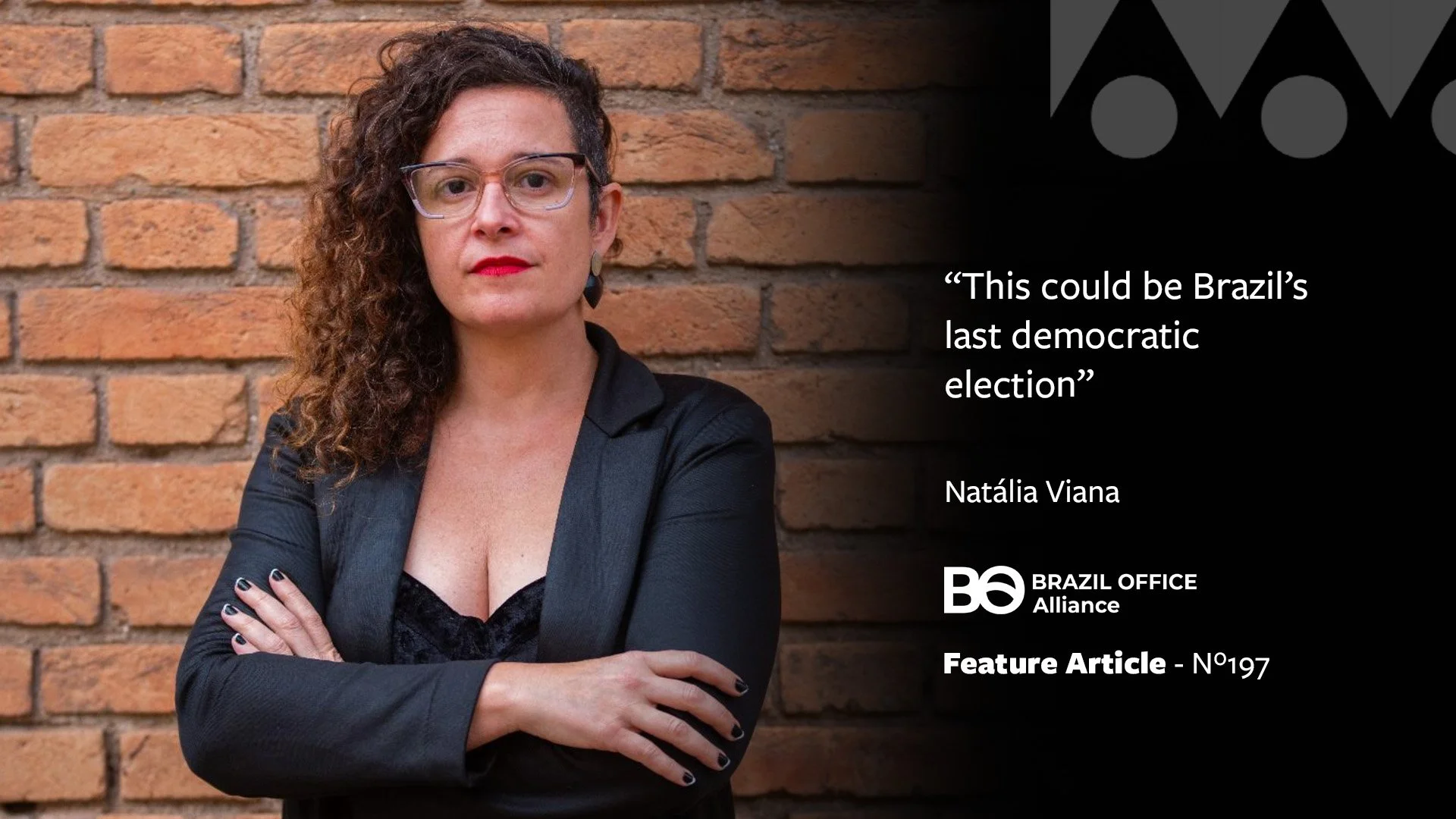
By Natália Viana*
They'll say it's about the market. They'll say it's about corruption, about Banco Master, about abuses of power by the Supreme Federal Court (STF). You'll read analyst after analyst saying that what's at stake is public safety, the fight against violence, economic policy. We need to control spending, they'll say. We need to privatize public companies, they'll proclaim. But the 2026 presidential elections are not about that, and we have to understand that once and for all.
Under Jair Bolsonaro's leadership, the election will be a true referendum on the existential question that plagues all nations around the globe today. Should we maintain our democratic regime, however flawed it may be, or should we ignore those who care about it and open space for new power arrangements with an authoritarian bent?
Bolsonaro is a master of low-level politics, and he knew that having his last name on the ballot would be a huge advantage from the start. But, regardless of which name solidifies in the right-wing field, the "payoff" to be awarded the family is guaranteed: a pardon for the chief coup plotter. And, therefore, let Brazil embrace a narrative that there were never any coup attempts. Let all those coup plotters involved be granted amnesty – from the old lady to the generals.
The always measured political analysts will say that since Bolsonaro has the support of half the country, perhaps this is the price to pay. That's why this warning is explicit. Let's see what that price is.
Perhaps the biggest consequence of the upcoming election for the right is embracing Bolsonaro, as it certainly will do. However, our business community needs to abandon this naive illusion. The candidate who has votes and can mobilize the right is Bolsonaro who will destroy the only example of how one can confront the techno-fascist assault that is currently plaguing hundreds of countries through the judiciary and the democratic rule of law.

Brazil gave the world this example.
Let's go back in time a little to understand what we have achieved as a society from 2023 until now.
It is worth remembering the details of that nightmare. The invasion of the Praça dos Três Poderes (Three Powers Square) on January 8th of that year was the culmination of a plot spanning more than four years by Jair Bolsonaro and his group – including, of course, his sons Eduardo and Flávio. They used federal government resources to finance and spread disinformation about elections. They created a parallel intelligence agency (ABIN) to investigate enemies. They rigged the Federal Police for the same purpose and sought foreign support for the narrative about electoral fraud (remember the meeting with ambassadors?). They mobilized the Ministry of Defense to pressure the Electoral Court and drafted a document stating that it could not guarantee the integrity of the ballot boxes. They ordered the highway police to prevent authorities from reaching the polling stations, to give just a few examples.
All of this happened before the attempted coup d'état itself, whose plans were very well documented by the judicial process in the Supreme Federal Court (STF) for which Jair Bolsonaro was convicted and is imprisoned. They included, among other things: a) a plan to kill President Lula da Silva, Vice-President Geraldo Alckmin, and STF Justice Alexandre de Moraes; b) the declaration of a state of siege and the decree of an Operation to Guarantee Law and Order; and c) the arrest of the Supreme Court justices.
To execute his plan, Bolsonaro held 14 meetings with the military leadership. In the meetings of December 7th and 14th, 2022, he discussed a coup proposal that suggested declaring a state of siege. In the meeting on the 14th, he met with the Army commander, Marco Antônio Freire Gomes, who would have been arrested if he had tried to proceed with the plan.
All of this happened. It's on record. It's part of history.
After the invasion of the Praça dos Três Poderes, Brazil achieved the following unprecedented results:
Making Bolsonaro ineligible for office;
Conducting an exemplary investigation into the coup plans;
Trying 31 people for planning the coup d'état and convicting 29, including 22 military officers, among them, Generals Walter Braga Netto, Augusto Heleno, Paulo Sérgio Nogueira, and Mário Fernandes, along with Admiral Almir Garnier, former commander of the Navy;
Trying and convicting other coup plotters;
Holding two commemorative events to remember the attempted coup d'état and planning a memorial.
All this has popular support. According to Datafolha, 54% of the population believes Bolsonaro's imprisonment was just, compared to 40% who consider it unjust.
So, the referendum that will take place in the October elections will be about whether Brazil continues in this direction and rids itself of the ghost of coup-mongering once and for all, or whether it decides to make a U-turn and jeopardize all these collectively built measures.
But there's something more. Because of the international context, our national sovereignty is at stake, more than at any other time.
While institutionally fighting against the coup attempt, Brazil became a global bastion for the regulation of digital platforms that profit from disinformation and extremist and anti-democratic discourse. Brazil managed to place the debate on "information integrity" on the international agenda, which appeared in the G20 declaration issued at a meeting held in Brazil. It also managed, through a decision of the Supreme Federal Court, to partially suspend Article 19 of the Brazilian Internet Bill of Rights (Marco Civil da Internet), which prevented any liability for Big Tech companies for content posted on their networks, even if it was paid for, criminal in content, and provided profits. Brazil also approved the Digital Statute of Children and Adolescents (ECA Digital). This measure established responsibilities for Big Tech companies to protect children and adolescents, prohibited the use of AI in electoral campaigns, prioritized the regulation of streaming services like Netflix, and discussed a regulation of Artificial Intelligence that compensates those who work to generate knowledge.

In retaliation, in the middle of last year, the US government imposed 50% tariffs on all Brazilian exports, the highest rate in the world. These tariffs caused millions in losses, but now it seems they are in the past. Even so, Brazil is still being investigated by the Office of the U.S. Trade Representative for “unfair trade practices,” including rules imposed on Big Tech companies. Supreme Court Justice Alexandre de Moraes was targeted by the Magnitsky Act and is still facing a lawsuit in Miami initiated by Donald Trump's company, Trump Media, owner of the social network Truth Social.
All these retaliations against Brazil’s actions aim, on the one hand, to leave behind the ghost of coup attempts and, on the other, to exorcise this ghost in its digital guise. By carrying out the necessary regulation of Big Tech companies and holding them accountable for the crimes they allow and from which they profit, Brazil has revealed that the U.S. government's intention is to defend its interests and to deny Brazil the capacity to protect its society and citizens.
There's no one who works harder to surrender all Brazilian independence to the U.S. government than Eduardo Bolsonaro, brother of the future candidate, Flávio, and son of Jair, who has been organizing an international conspiracy since March 2025 to end any action representing Brazilian autonomy.
In January 2026, Flávio Bolsonaro was alongside his brother and Paulo Figueiredo to meet with the same circle of support they both built in the United States, which convinced the White House to retaliate against Brazil. There is no greater evidence that candidate Flávio follows the submissive alliances of his brother Eduardo.
Even though Trump says he "gets along well" with President Lula da Silva, it's clear he prefers a Bolsonaro supporter. Recently, according to Reuters, the State Department appointed a radical right-winger as "senior advisor for Brazil policy." Darren Beattie is Under Secretary of State for Public Diplomacy and an important ally, having met several times with Eduardo Bolsonaro and Paulo Figueiredo in the months before the tariff hike. Last August, he tweeted that Alexandre de Moraes was “the main architect of the censorship and persecution complex directed against Bolsonaro.”
A victory for Flávio, therefore, also means throwing away all the progress made by Brazil and recognized internationally as a leader in the discussion of digital governance.
Finally, to conclude the reasoning articulated at the start of the article: with Flávio Bolsonaro's candidacy, we are literally looking at the edge of the abyss.
There is no possibility of having Jair's son in the Planalto Palace without pardons or an amnesty for the participants in the attempted coup of January 8th. Moreover, there is no chance that this pardon will not be accompanied by the narrative that they were actually patriots, and were, in fact, denouncing a fraudulent election.
In politics, half-truths never stand up. Either you tell the whole truth, or the population will never believe it. This is what happened in 1979 with our broad, general, and unrestricted amnesty. If everyone was pardoned, if no one spoke anymore about the alleged torture, then perhaps the military regime was a "mild dictatorship."
Similarly, either there was a coup and its perpetrators must be punished, or there was no coup. There is no middle ground.
Having sold this narrative, the spirit of justice will necessarily demand that those who perpetrated these abusive arrests be investigated and punished. This will open the space for investigations against the prosecutors, federal police officers, journalists, judges, and Supreme Court justices who participated in elucidating the nature of the crimes of January 8th. This is exactly what has happened in the United States.
On the other hand, a national alliance that, with great difficulty, managed to reinforce the confidence that our society has in the electoral system, in the electoral justice system, and in the electronic voting machines will be fractured.
After all, if there was one fraudulent election, how many more could there be? The sequence will be the use of electoral manipulation in its most varied forms: reduction of staff, amplification of the fraud narrative, hiring of hackers, more police trying to prevent voters from voting. However, this time there will be less popular resistance.
In short, this could be Brazil’s last democratic election.
*Natália Viana is co-founder and executive director of Agência Pública, where this article was originally published on March 2, 2026.
