
After October, November: Why the Midterms Matter to Brazil
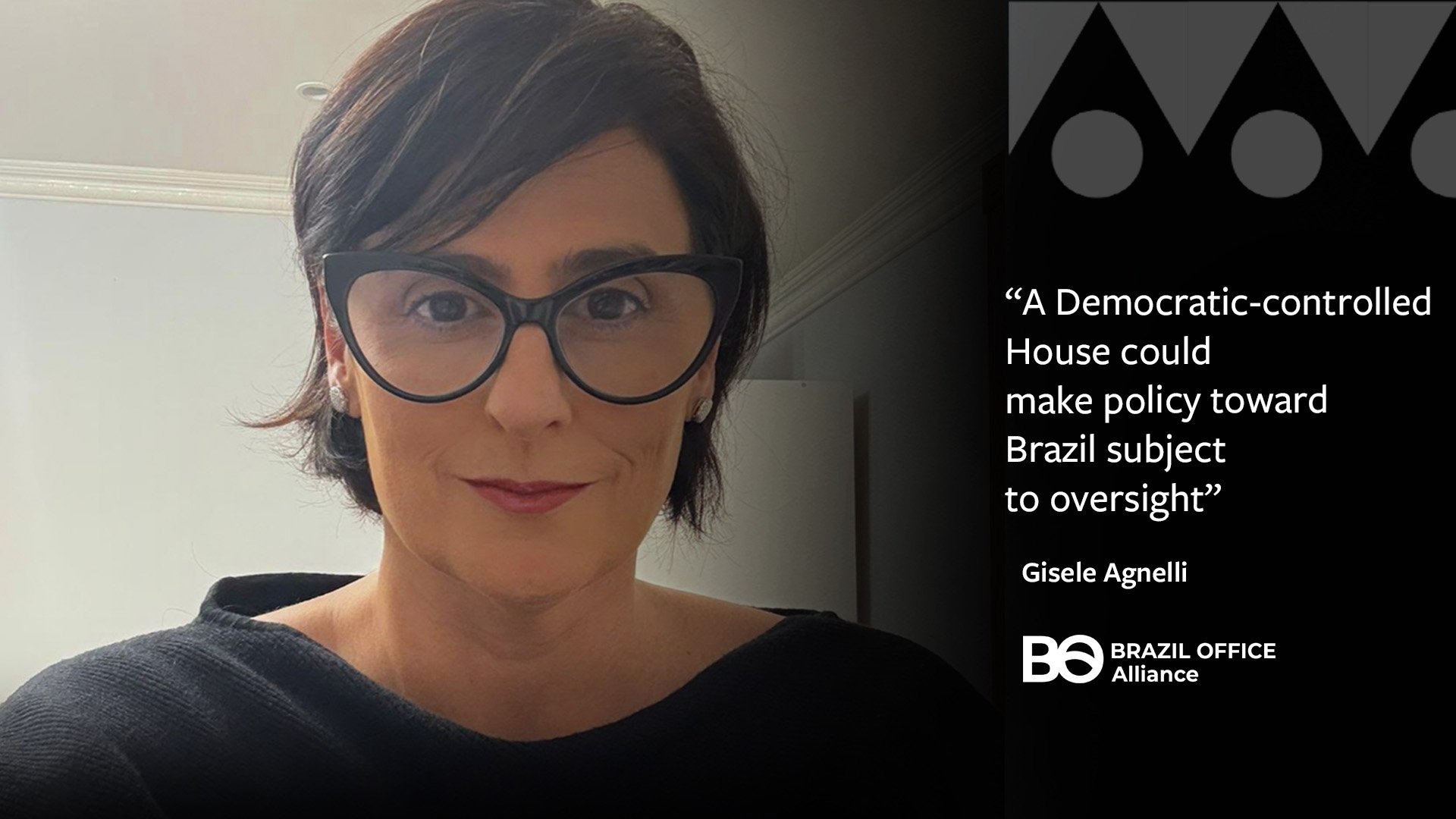
By Gisele Agnelli*
With the U.S. midterm elections just over a month away, the most important question may not be whether Donald Trump will lose control of Congress, but what will happen to his presidency if he does. For Brazil, the issue matters even more. During his term, Trump has not only expanded the boundaries of U.S. executive power but has also transformed trade, sanctions, and foreign policy into increasingly personalized instruments of pressure. Brazil has become one of the clearest examples of this transformation.
Trump’s political decline is now hard to ignore. A Reuters/Ipsos poll released on September 21 placed his approval rating at just 32%—the lowest of his political career in that series. This erosion of support is deeply linked to the cost of living and the conflict with Iran, which drove up fuel prices and heightened the sense of economic insecurity. In the same survey, Democrats led Republicans by eight points in voter preference for the legislative elections.
In the districts where the election will actually be decided, the picture is equally concerning for the White House. A Cook Political Report survey of 37 competitive districts shows Democrats leading 49% to 47%. On average, these same districts had given Trump a five-point lead in 2024. This represents a seven-point swing. In these areas, only 42% approve of the president, while 58% disapprove.
Trump has recognized the risk and is attempting to turn the midterms into a referendum on himself. He urged Americans to vote as if their own names were on the ballot and even promised a $5,000 "Trump dividend" to every adult citizen should Republicans retain control of the House and Senate. This pledge would cost over $1 trillion and, in practice, depend on Congress itself to approve the measure.
This strategy contains a contradiction. The more Trump turns the election into a referendum on his presidency, the more he forces Republican candidates in competitive races to decide how closely they wish to tie themselves to him. There is no uniform flight from Trump. Republican advertising still features him heavily. Still, candidates are already seeking some distance on issues such as war, the cost of living, and immigration. It is a classic midterm election tension. The president wants to nationalize the contest, while vulnerable lawmakers need to localize it.
The House currently represents the primary area of risk for Republicans. The Senate landscape is structurally more challenging. Republicans hold 53 seats against a bloc of 47 Democrats and party-aligned independents. Since Vice President JD Vance casts the tie-breaking vote in a 50-50 Senate, Democrats need to reach 51 seats—a net gain of four. The electoral map has become more competitive, yet it still requires a difficult string of victories.
This matters because a Republican defeat would not necessarily result in a less active Trump. It could produce the exact opposite: a Trump who is legislatively weaker but executively more aggressive.
If Democrats win only the House, a major Republican legislative agenda passing with party-line votes alone vanishes. But something perhaps more important changes hands: committee chairmanships. These bring with them investigations, subpoenas, hearings, access to documents, and budgetary power. A Democratic-controlled House could not undo all of Trump’s decisions, but it could enormously raise the institutional cost of doing so.
If Democrats also win the Senate, another check would emerge: appointments. Federal judges, cabinet members, and hundreds of other positions depend on the Senate’s "advice and consent." A potential Supreme Court vacancy would turn this power into a historic issue.
Even so, it would be a mistake to imagine Trump paralyzed. Trade, immigration, regulation, sanctions, and foreign policy offer the U.S. Executive tools built up over decades of legislative delegation. The likely result would be a presidency more reliant on executive orders, previously delegated powers, and litigation—an even greater shift of political conflict from Congress to the courts.
The Supreme Court has already demonstrated that this scope is not infinite. In February, in the case Learning Resources v. Trump, it ruled that the International Emergency Economic Powers Act did not authorize the president to impose tariffs. The decision served as an important constitutional reminder: even for a powerful presidency, delegation does not mean unlimited power.
This is where the U.S. midterm elections intersect with the Brazilian election.
A potential Democratic victory in November would not automatically end the tariff offensive against Brazil. The most significant effect would be different: it would curtail Trump’s ability to manage the bilateral relationship virtually without political pushback in Washington.
In Brazil's case, trade and domestic politics have already overlapped in an exceptionally explicit way. In 2025, the White House itself linked extraordinary tariffs on Brazil to the treatment of Jair Bolsonaro, decisions by Brazilian institutions, and the country's ability to hold a presidential election that Washington deemed free and fair. In July of that year, the USTR added a 25% tariff on certain Brazilian products after concluding a Section 301 investigation covering digital trade and payment systems, intellectual property, ethanol, anti-corruption efforts, and deforestation.
The recent revelation of a U.S. proposal presented to Brazil in October 2025 makes this intersection even more evident. The 21 points on the table included purchases of Boeing aircraft and critical minerals, as well as a commitment that Brazil would hold “free and fair” elections in 2026 without arbitrarily restricting the participation of “political dissidents.” Jair Bolsonaro was not mentioned by name. Yet the mere fact that political-electoral conditions appeared in a trade negotiation shows how porous the boundary between trade and political pressure has become.
There is, however, a fundamental temporal asymmetry. The first round of Brazil’s election took place on October 4, and the runoff is on October 25. The U.S. midterm elections will be held on November 3, and the new Congress takes office on January 3, 2027. Therefore, any immediate reaction by the Trump administration to the Brazilian result would occur while the current Republican-controlled Congress is still in session.
Only after that would a potential Democratic majority begin to alter the bilateral landscape.
A Democratic-controlled House could make policy toward Brazil subject to oversight: summoning officials from the State Department, the Treasury, and the Office of the U.S. Trade Representative (USTR); demanding documents; investigating the use of trade instruments for political objectives; and using the appropriations process to impose limits. With control of both chambers, Democrats could attempt to revise the trade powers delegated to the Executive—including by imposing new conditions on the use of Section 301.
Even so, it would not be simple. Trump could veto restrictive legislation, and overriding a presidential veto requires a two-thirds vote in each chamber. Furthermore, certain powers would remain fundamentally presidential. In Zivotofsky v. Kerry, the Supreme Court held that only the president can formally recognize foreign governments. A hostile Congress can restrict resources, trade, and foreign policy tools. However, it cannot simply supplant the president in recognizing another government.
Another transformation is underway within the Democratic Party. It is tempting to describe it as a shift toward democratic socialism, driven by the rise of Zohran Mamdani in New York, Alexandria Ocasio-Cortez, and now Abdul El-Sayed in Michigan. However, that interpretation oversimplifies a far more complex coalition.
Recent Pew research shows that 39% of Democrats and Democratic-leaning independents consider themselves more liberal than the Democratic Party itself; nearly the same proportion—36%—consider themselves more conservative. Dissatisfaction, therefore, runs in both directions.
Pew’s political typology is even more revealing. "Leftward Progressives" represent just 7% of Americans. Meanwhile, the group known as the "Order and Opportunity Left"—economically more liberal but more moderate on various social, immigration, and security issues—accounts for 18% of the country.
Mamdani showed that the economic left has immense political energy focused on affordability: rent, transportation, childcare, and the cost of living. El-Sayed may represent a more significant national test because his insurgent campaign took place in Michigan—a competitive, decisive industrial state—rather than in a progressive coastal enclave.
However, this faction of the left does not yet control the national Democratic establishment. Hakeem Jeffries leads the party in the House, and Chuck Schumer in the Senate. The Democrats' perennial challenge remains turning overwhelming majorities in New York, Boston, or Los Angeles into a coalition that can win over the Midwest, the Sun Belt, mid-sized cities, suburbs, and working-class voters.
For this reason, the phenomenon may be less of a "shift to the left" than a struggle over the nature of the Democratic Party's reconstruction after Biden—and, above all, after Trump.
For Brazil, this internal reorganization of the Democratic camp also has a diplomatic dimension. On September 21, in New York, Lula held separate meetings with Zohran Mamdani and Bernie Sanders. His conversation with Mamdani touched on democracy, extremism, disinformation, and the cost of living. With Sanders, the discussion explicitly addressed the U.S. midterm elections and the Brazilian election, with the senator advocating for Brazil's right to self-determination. These meetings should not be interpreted as a Brazilian bet on a Democratic victory, much less as a substitute for institutional dialogue with the White House. Their significance is more nuanced: given a bilateral relationship overly focused on the U.S. presidency, Brazil has an interest in rebuilding channels with Congress, local governments, and political factions that could gain influence after November. Mature diplomacy does not pick the winner of a foreign election in advance. It diversifies interlocutors so a state-to-state relationship is not held hostage by a single administration or political camp.
The influence of the new left may far exceed its numerical weight. It does not need to control the party to alter its rhetoric. It has already shifted the conversation toward the cost of living, healthcare, economic concentration, corporate power, labor unions, and campaign finance. The challenge is combining this anti-establishment energy with political language that can forge a national majority.
This is also why the November elections are about more than just congressional seats.
Trump spent much of his term expanding a highly centralized presidency. If he loses one or both chambers, the United States will enter a different kind of experiment: an attempt to rebuild—amid Trumpism—the checks and balances that partisan polarization has eroded.
For Brazil, this shift could be just as significant as any tariff reduction. Currently, Brasília negotiates primarily with a strong presidency backed by a Republican Congress. Come January, it may also find itself negotiating with Democratic committees, facing legislative inquiries, and dealing with a Congress willing to question how trade, technology, strategic minerals, sanctions, and Brazilian domestic policy were all bundled into the same framework of pressure.
Brazil’s elections will conclude before Americans go to the polls. Yet, the consequences of both elections will converge in Washington starting in January.
The question, therefore, is not merely whether the midterms will succeed in “stopping Trump.” The question is whether they can restore something to American politics that became increasingly scarce during his second term: institutional checks and balances.
For Brazil, this would mean something equally important: putting the bilateral relationship back in a framework where economic pressure, foreign policy, and sovereignty no longer depend almost exclusively on the will of a single president.
*Gisele Agnelli is a political scientist and sociologist who graduated from PUC-SP and works between Brazil and the United States. She is the author of Autocracy Made in the USA, which analyzes the impact of Trumpism on liberal democracy. A columnist for Congresso em Foco and a guest commentator for CBN São Paulo, she researches democratic erosion, contemporary authoritarianism, and Brazil-US relations. An alumna of the Hoosier Women Forward program, she founded the #VoteNelas movement and the Brasileiras na Florida Book Club. She is a member of transnational networks dedicated to research and the defense of democracy, focusing on civil rights, governance, and institutions. She produces analyses regarding democracy, international politics, and the rule of law, with an emphasis on contemporary challenges.
