
Distrust as an Election Manipulation Strategy
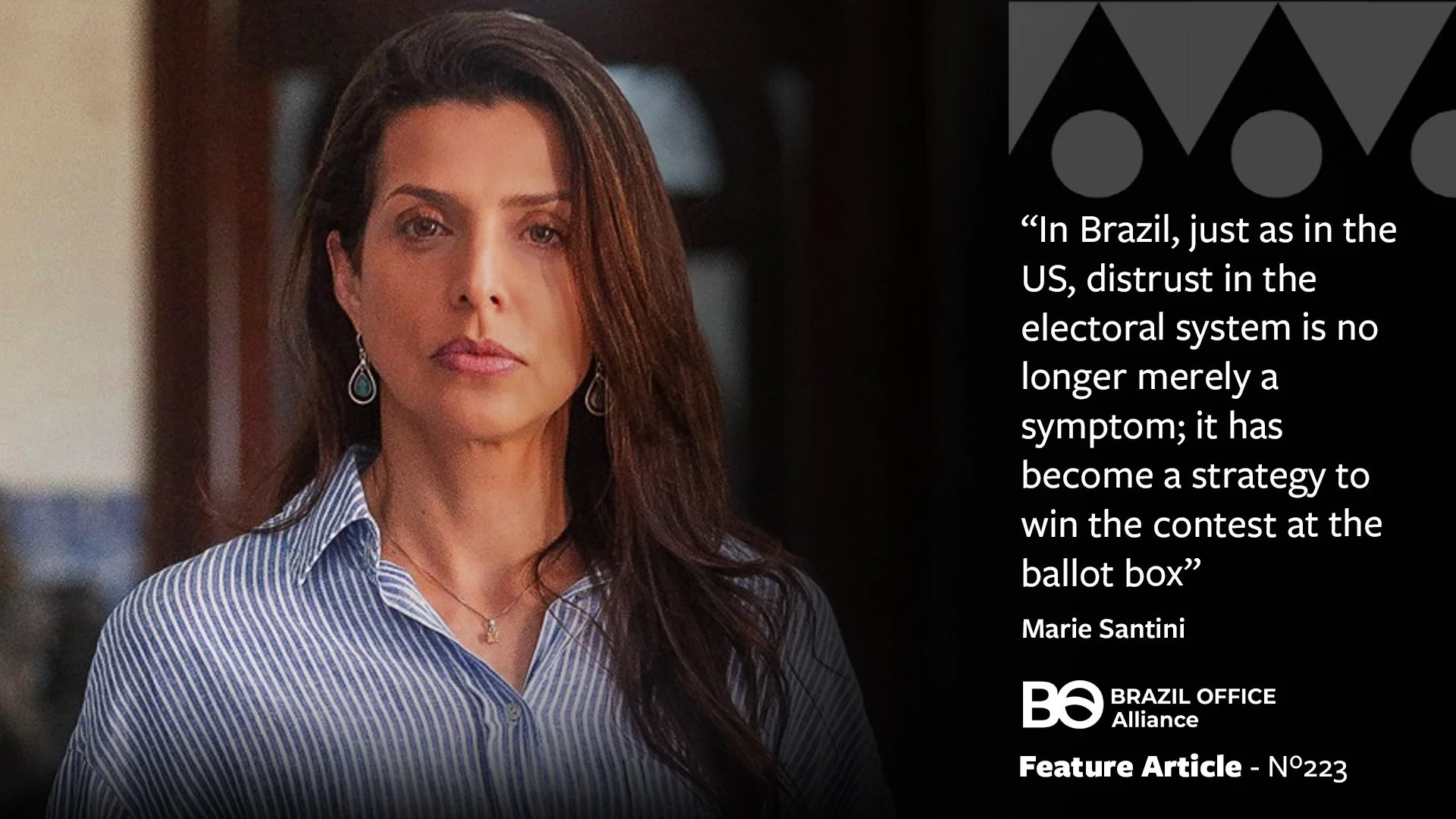
By Marie Santini*
The history of democracies is inseparable from constant tensions and questioning. However, we are currently experiencing a profound crisis of confidence in democratic institutions across the West. What is new is not the questioning itself, but who organizes it and why—transforming distrust in democracy and the electoral process into a deliberate political instrument to annihilate dissent.
This phenomenon is linked to the growing affective polarization of the American public and was imported by the Brazilian far-right, which follows the same playbook. In Brazil, just as in the United States, distrust in the electoral system is no longer merely a symptom; it has become a strategy to win the contest at the ballot box—or outside of it.
Historically, the press and mass media monitored democratic institutions, but they often failed to engage the average citizen or foster continuous political participation. Social media transformed politics into a product for compulsive consumption, turning political communication into a battlefield of competing narratives that exploits the logic of "permanent campaigning." Influencers, algorithms, and online communities turn politics into a nonstop spectacle driven by traction, reactions, engagement, and revenue.
This shifts the very foundation of political trust. Before the advent of social media, legitimacy and trust bestowed moral authority on institutions. Today, that logic has been inverted: political stance and moral values now define whom and what one trusts. Recommendation algorithms drive this inversion by helping to build communities of belief and "echo chambers." They operate on a logic of actively discrediting dissenting voices, making members dependent on sources approved by the group and insulating them from contradictory evidence.
Data on perceptions of electoral integrity objectively illustrate this organized distrust. In Brazil, confidence in electronic voting machines fell from 82% in 2022 (when Bolsonaro was the incumbent) to around 53% in 2026, with Lula in power. The collapse in confidence regarding the ballot boxes is concentrated among voters on the losing side: today, only 22% of Bolsonaro voters trust the electoral system, compared to 75% of Lula voters. In the United States, the most telling figure relates to this reversibility: Republican confidence jumped from 24% to 64% in the weeks following Trump's victory. The same pattern appears in Republicans' perception of the result's legitimacy, as measured by Bright Line Watch: it rose from 27% in 2020 to 97% in 2024. Among Democrats, confidence in the electoral system moved in the opposite direction, shifting from 97% to 83%. The drop in confidence among Democrats was moderate. In contrast, confidence among Republicans nearly fully recovered—confirming that perceived legitimacy among the right and far-right tracks much more closely with who won than with any technical criteria regarding the electoral process itself.
This pattern reveals the dual function of the organized cultivation of distrust: to increase voter abstention and, simultaneously, to lay the groundwork for eventually challenging an unfavorable result. In other words, Republican confidence in the electoral system returns only when the outcome reinforces their partisan base's preferences.
NetLab UFRJ studied a concrete example of this permanent campaign against Brazil's electoral system. Since the 2018 election, Jair Bolsonaro has continuously propagated conspiracy theories regarding the vulnerability of electronic voting machines, fueling a stream of disinformation that intensified in the run-up to the vote. During the 2022 election campaign, we identified spikes in messages regarding alleged electoral fraud within WhatsApp and Telegram groups—concentrated around strategic dates (such as the eve of the first round of voting and September 7th)—featuring identical texts replicated en masse and showing signs of coordinated dissemination rather than spontaneous outrage. Federal Police investigations later revealed that this architecture of delegitimization—amplified by high-profile, pro-Bolsonaro influencers—also underpinned the preparations for a coup that culminated in the events of January 8, 2023.
This is precisely the mechanism of the echo chamber: distrust is not a byproduct of information and critical thinking, but a manipulative structure designed to shut out dissenting views. These campaigns use algorithms that amplify voices within online groups, artificially inflating the perception of scale and consensus.
These are the risks Brazil faces in the 2026 elections. When distrust is orchestrated by a political group, fueled by perpetual campaigning, and amplified by recommendation algorithms, it ceases to be merely a byproduct of democratic life and transforms into a political technology: it comes to underpin the determination of who is deemed credible and who is to be viewed with systematic suspicion—and, ultimately, who should see their power expanded and who should be destroyed or annihilated.
Sources for data on trust in electronic voting machines:
• Brazil: Datafolha (82% trust in 2022) and Genial/Quaest, February 2026 (53% trust, with a breakdown by candidate preference in 2022).
• United States: Gallup (historical series on trust in the national vote count and a 56-point partisan gap in 2024); Bright Line Watch (perception of electoral result legitimacy, 2020 vs. 2024, by party); AP-NORC (shift in Republican trust from 24% to 64% following the 2024 election).
*Marie Santini is a professor at the School of Communication at the Federal University of Rio de Janeiro (UFRJ) and the founder and director of Netlab (UFRJ’s Internet and Social Media Studies Laboratory).
