
U.S. Action Pushes Brazil’s Election Back onto Programmatic Ground
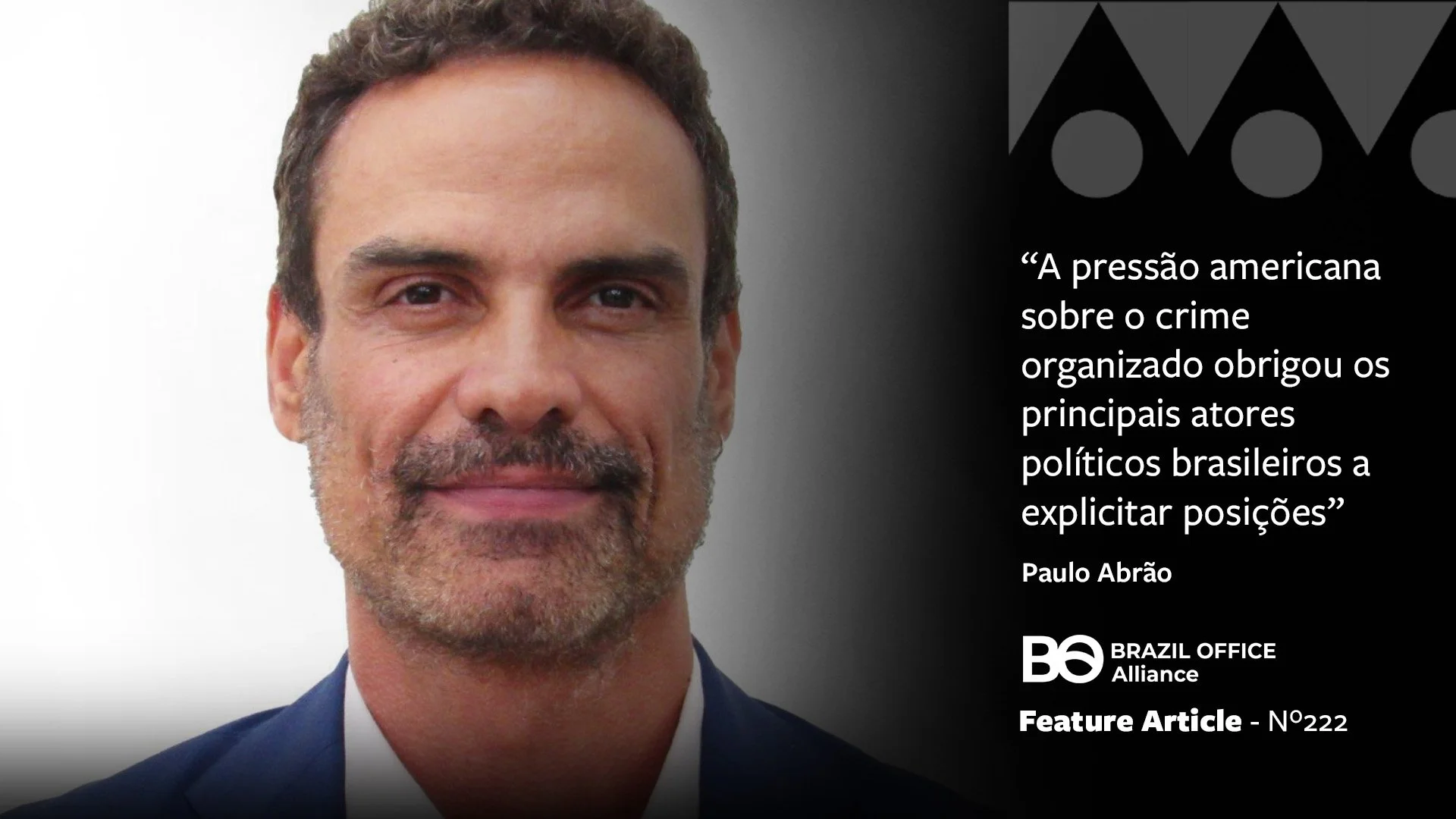
By Paulo Abrão*
Brazil’s presidential election had been increasingly consumed by a crisis that did not originate in the campaign itself. A succession of episodes involving the Supreme Court, the Federal Police, Banco Master, investigations into Supreme Court justices, information leaks, conflicting rulings, and mutual accusations produced an electoralization of the justice system and, at the same time, an even greater judicialization of the election. For weeks, the question of which candidate, platform, and vision for the country will be at stake in October seemed to be losing ground to a crisis that is eroding the Court’s authority.
Yet, with only days to go before the election, an unexpected paradox has emerged. The Trump administration, precisely by increasing U.S. pressure on Brazil, has helped push the campaign back onto programmatic ground. Not because Washington has any legitimacy to define Brazil’s electoral agenda, but because one of its most recent measures touched precisely on an issue everyone knew would be central to this campaign: public security.
On September 15, the White House sent Congress its annual determination on major drug-producing and drug-transit countries. Although Brazil was not included in the document’s most negative formal categories, the Trump administration singled it out for criticism. It said the Brazilian government had failed to confront the Primeiro Comando da Capital (PCC) and Comando Vermelho (CV), blamed the two Brazilian criminal organizations for turning the country into a hub for international cocaine flows, and called for tougher measures against them.
The accusation did not emerge in a political vacuum. In May, during a visit to Washington amid the pre-campaign period, Flávio Bolsonaro asked the U.S. government to designate the PCC and Comando Vermelho as terrorist organizations. On May 28, following Flávio’s meetings with Trump, J.D. Vance, and Marco Rubio, the U.S. government announced the designation, which took effect on June 5. Flávio publicly celebrated the decision, and members of his pre-campaign said they intended to use the security issue politically during the election.
None of this demonstrates that the new September rebuke was intended to benefit a Brazilian candidacy. Washington’s intentions cannot be presumed. Officials from Brazil’s Ministry of Justice and Federal Police have said they see a political-electoral dimension to the U.S. statement, but that is the interpretation of Brazilian authorities, not a proven intention of the Trump administration.
The effect on the electoral agenda, however, can exist independently of intent. For months, we have known that public security would be a major area of programmatic differentiation in this election. No presidential candidacy could make it through 2026 without answering an unavoidable question: how does the Brazilian state intend to confront criminal organizations that control territories, move billions of reais, infiltrate legitimate economic activities, operate across borders, and challenge the capacity of public institutions?
And that is exactly what happened this Friday, September 18. In Rio de Janeiro, Lula responded directly to Trump, rejected the classification of the PCC and CV as terrorist organizations, but said that the country needs to defeat organized crime. At the same event, the federal government and the government of Rio de Janeiro presented joint measures to reclaim territories controlled by criminal factions, militias, and other criminal organizations, involving intelligence, investigation, technology, and coordinated action by security forces.
The disagreement has therefore become programmatic. The debate now encompasses the legal classification of criminal factions, coordination between the federal government and the states, the fight against money laundering, border control, financial intelligence, international cooperation, and the limits of a foreign power’s participation in Brazilian security policy. Flávio supports designating the PCC and CV as terrorist organizations and closer alignment with the U.S. strategy. Lula rejects that classification and presents a different approach to confronting organized crime. What was becoming an election about possible corruption involving Supreme Court justices is returning, at least in part, to an election about public policy.
The episode is particularly interesting because, when we think about electoral interference, we tend to imagine campaign financing, intelligence services, indirect propaganda, disinformation operations, or material support for a particular candidate. But contemporary elections take place in a far more complex transnational environment. A foreign power does not necessarily have to tell Brazilian voters whom to vote for to influence an election. It can also acquire the capacity to influence what Brazilian voters will be voting about.
This is a less discussed dimension of foreign influence. Introducing an issue, changing its position in the hierarchy of public concerns, imposing categories through which it is interpreted, or increasing the political cost of a position can alter the environment in which an election takes place. And this is what makes the Brazilian case particularly paradoxical. The Supreme Court crisis had shifted much of the electoral debate into the courts. U.S. pressure over organized crime is now helping restore a typically programmatic issue to the center of the campaign. Trump obviously did not create Brazil’s public-security problem, nor did he introduce the issue into the campaign. But the U.S. initiative has increased its salience and compelled Brazil’s main political actors to make their positions explicit.
And this paradox will now reach the United Nations. The controversy has erupted on the eve of the opening of the UN General Assembly. Lula had already made sovereignty and non-interference themes of his international agenda. Following the U.S. criticism concerning the PCC and Comando Vermelho, the fight against organized crime is also expected to feature in his UN address. The government's position combines the defense of Brazilian sovereignty with international cooperation against transnational phenomena, conditioned on respect for international law.
This combination matters because sovereignty does not mean isolation. Organized crime is transnational, as are the financial flows that sustain it, and these phenomena can no longer be confronted exclusively within a single state's territorial boundaries.
The Brazilian paradox is that this time, external pressure has helped push the campaign back toward an issue it would inevitably have had to confront. And that does not diminish the importance of sovereignty. On the contrary, it shows that, in the twenty-first century, protecting the autonomy of an election means protecting not only a society’s right to choose its leaders freely, but also its capacity to decide for itself what it intends to decide when it goes to the polls.
*Paulo Abrão is the Executive Director of the Washington Brazil Office (WBO). He served as Brazil’s National Secretary of Justice. He also served as Executive Secretary of the Inter-American Commission on Human Rights of the Organization of American States and as Director of the Mercosur Institute of Human Rights. He was a visiting scholar at the Watson Institute for International and Public Affairs at Brown University.
