
The priority in 2026 is to defend democracy in Brazil
By Paulo Abrão*
Brazil will hold national elections in October of this year. The first round will be on the 4th and the second on the 25th. More than 150 million voters will go to the polls to vote for their candidates for President of the Republic, State Governor, Federal Deputy, State Deputy, and Senator.
Officially, there are still no registered candidacies, which should only happen in April. But unofficially, it is already known that the current president, Luiz Inácio Lula da Silva, is expected to run for a fourth term, while, on the opposite side, the opponent is Senator Flávio Bolsonaro, one of the sons of former president Jair Bolsonaro, who is now imprisoned and ineligible after being convicted by the Supreme Federal Court for his participation in a failed coup attempt in 2023.
The picture on the left is clearer, with Lula assuming his usual leading role, without questioning within his own political sector. The current president appears as the favorite in all polls. On the opposite side, there is a poorly disguised divergence between the Bolsonaro family and other exponents of the far right who, although they do not openly confront the former president, are trying to find their own space. Flávio's nomination was surprising, as the bets until then were on the current governor of São Paulo, Tarcísio de Freitas, one of the many reserve military officers who served as ministers under Bolsonaro.
Regardless of which candidates are officially presented in April, this will be a gigantic electoral marathon, marked by challenges on a continental scale, in the year that the country celebrates 41 years of redemocratization, counted from the end of the military dictatorship in 1985, and 30 years of the electronic voting system, which began to be implemented in 1996.
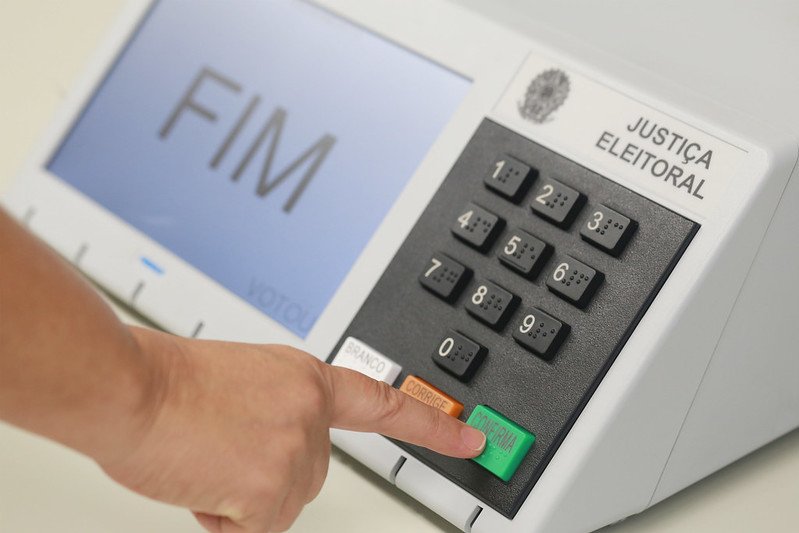
Both anniversaries are, at the same time, a reason for celebration and concern, because it was through unfounded questioning of the Brazilian electronic voting system that a new radical far-right movement began to attack democracy in the country, starting with the last presidential elections, held four years ago. It was through the dissemination of fake news about electronic voting machines that the Brazilian far-right began its journey of undermining democratic institutions, culminating in the failed coup attempt of January 8, 2023.
There is a risk that, in this year's election, this same political sector will return with massive disinformation campaigns about electronic voting machines. However, this time, these same sectors will appear better connected to international actors who, in their respective countries, also use this same tactic to disrupt their own electoral systems and undermine their own democracies. It is enough to remember that the unfounded questioning of the results of the 2022 Brazilian presidential elections emulated similar questions made by the American far-right in the 2020 elections, and the coup attempts of January 8, 2023, were a reproduction of the similar coup attempt in the US in 2021.
Eduardo, brother of Flávio and son of Jair Bolsonaro, is a key figure in the articulation of the Brazilian far-right with its counterparts in the US. He established himself in American territory in March, from where he began to ask the Donald Trump administration to apply sanctions against ministers of the Supreme Federal Court, through the use of the Magnitsky Act, and to impose customs surcharges on Brazilian products exported to the US. The undertaking produced the expected results at the beginning, but then Lula managed to open a direct channel of communication with Trump and, surprisingly, not only reversed most of these measures, but also began to be mentioned positively by the American president, while Eduardo was left aside.
It is still too early to say that this current picture of the situation will remain unchanged until the October elections. In fact, the prevailing climate is one of distrust, as Lula and Trump represent antagonistic models that are in conflict in various parts of the world. Furthermore, the recent American offensive against Venezuela, coupled with explicit threats against Colombia and Cuba, suggests that Brazil could also be placed in this line of targeted countries. If the rhetorical path to achieve this end is the same one used against Venezuelans and Colombians, then Brazil must be prepared to deal with a deliberate scheme of political propaganda that dishonestly seeks to associate the Lula government with cartels and factions that have been classified as narcoterrorists by the American government. Certainly, it would be a deceitful and dishonest ploy, but no more so than all the ploys previously attempted by the far right for the same purpose, including questioning the electronic voting machines.
Whatever the scenario, the Brazil Office Alliance – comprised of its branches in Europe (Europe Brazil Office), the USA (Washington Brazil Office), and Brazil (Brazil Office Association) – is already prepared to work intensively in partnership with its network of affiliated organizations and with other Brazilian civil society organizations and movements to strengthen the democratic field and the defense of human rights; the environment; indigenous peoples and local communities; and the LGBTQIA+ community.
Whether through the production of scientific knowledge, through its network of associated researchers (research fellows), or the organization of Brazilian delegations to the USA and Europe, the Brazil Office Alliance will work intensively to accurately and reliably present the Brazilian reality abroad. Whether through dialogue with governments, parliamentarians, civil society, academics, and journalists, or through the publication of reference materials such as annual reports, thematic reports, newsletters, podcasts, articles, and interviews, we will remain steadfast, building and sharing knowledge and engagement so that democracy continues to be strengthened in Brazil, despite all the threats and challenges that lie ahead.
*Paulo Abrão holds a doctorate in law, is a former National Secretary of Justice (2011-14), former Executive Secretary of the Inter-American Commission on Human Rights (2016-20), and Executive Director of the WBO (Washington Brazil Office).
