
When is it Legitimate and legal to Seek Support from the United States and the World?
By Paulo Abrão*
The lobbying by the Brazilian far-right in the United States in recent months, aimed at imposing tariffs and other sanctions against Brazil and its authorities to obtain internal political and electoral benefits, is illegal. Equally illegal is conspiring internationally against the regular functioning of one's own democratic institutions.
However, whenever this illegality is pointed out, the exponents of this political field resort to a false equivalence to try to justify their conduct. In a deliberately misleading way, they compare the lobbying they are currently promoting in Washington with the public and transparent dialogues established, on the eve of the 2022 presidential elections, between representatives of Brazilian civil society and authorities of the Joe Biden administration, as well as with European and Latin American interlocutors. The intention is evident: to dilute the gravity of their own actions by making it seem that both initiatives are of the same nature. They are not.
The illegality of the Brazilian far-right’s international activities is encapsulated in the ruling handed down by the Supreme Federal Court on June 16, 2026, which convicted those responsible for the crime of coercion during judicial proceedings—specifically because, as the Court acknowledged, they sought to mobilize the U.S. government to adopt economic and diplomatic measures against Brazilian judicial authorities with the aim of coercing them and obstructing the free exercise of their constitutional functions.
None of this bears any resemblance to the dialogues held in 2022.
At that time, faced with the concrete risk of democratic rupture, representatives of Brazilian civil society engaged in dialogue with authorities from the United States, Europe, and Latin America to request something extremely simple: that they reaffirm their commitment to the integrity of the Brazilian electoral system and promptly recognize the election results, regardless of who won.
It was never requested that foreign governments impose sanctions, interfere in the internal political process, or exert any illegal pressure on Brazilian authorities. The request was limited to what constitutes ordinary practice in international relations between democracies: recognizing the results of free, transparent, and legitimate elections.
The very simplicity of this request reveals the gravity of the moment Brazil was experiencing. There were well-founded reasons to fear an attempt at institutional rupture, a fear that, unfortunately, proved justified by the events of January 8, 2023, and the subsequent investigations and convictions of civilians and military personnel involved in plans to prevent the inauguration of the legitimately elected president.
The difference between the two situations, therefore, is not only political; it is legal and ethical.
On the one hand, there is an attempt to weaken democratic institutions through international pressure directed against national authorities, using economic and diplomatic instruments to interfere in the functioning of the Brazilian state. On the other hand, there was an attempt to strengthen the Democratic Rule of Law by encouraging respect for constitutional rules and international recognition of a legitimate electoral process.
In one case, the intention is to instrumentalize international power to constrain democratic institutions. On the other hand, the aim is to strengthen the international legal order founded on the defense of democracy and human rights, and on respect for election results.
This distinction also stems from the profound transformation that has occurred in international relations in recent decades.
For a long time, the prevailing conception was that only states produced international law, negotiated treaties, and conducted diplomacy. Civil society remained practically excluded from this space.
This reality has changed profoundly.
Today, civil society organizations participate in the negotiation of international treaties, present cases before international tribunals, monitor compliance with conventions, influence global public policies, produce indicators used by the United Nations, engage directly with multilateral development banks, participate in climate conferences, are part of G20 working groups, and play a decisive role in the evolution of contemporary international law.
Civil society has become a structural actor in global governance. Its participation has ceased to be exceptional and has become an indispensable element of the legitimacy, implementation, and control of international law.
It is precisely within this context that the work of the Aliança Brazil Office takes place.
For years, we have worked to build and maintain permanent channels for international dialogue—whether in the United States through the Washington Brazil Office or in Europe through the Europa Brazil Office. This was the case in 2022, when we organized missions by Brazilian civil society to Washington and Brussels to engage with officials, lawmakers, and international organizations regarding the risks facing Brazilian democracy. It remains the case in the various initiatives we undertake to defend democracy, human rights, the environment, Indigenous peoples, labor unions, traditional peoples and communities, the Black movement, LGBTQIA+ communities, freedom of expression, and artistic freedom.
In historic moments of heightened democratic tension, civil society has not only the right but the responsibility to make its voice heard beyond national borders. This was true in 2022 in the face of an internal threat to Brazilian democracy. It is true again in 2026, as external pressures are mobilized to weaken the country's institutions. In both instances, international engagement seeks to protect—not attack—the Brazilian constitutional order.
International engagement—whether with the United States or any other country—cannot be criminalized in and of itself. Nor is it the exclusive prerogative of governments, diplomats, business leaders, or political parties.
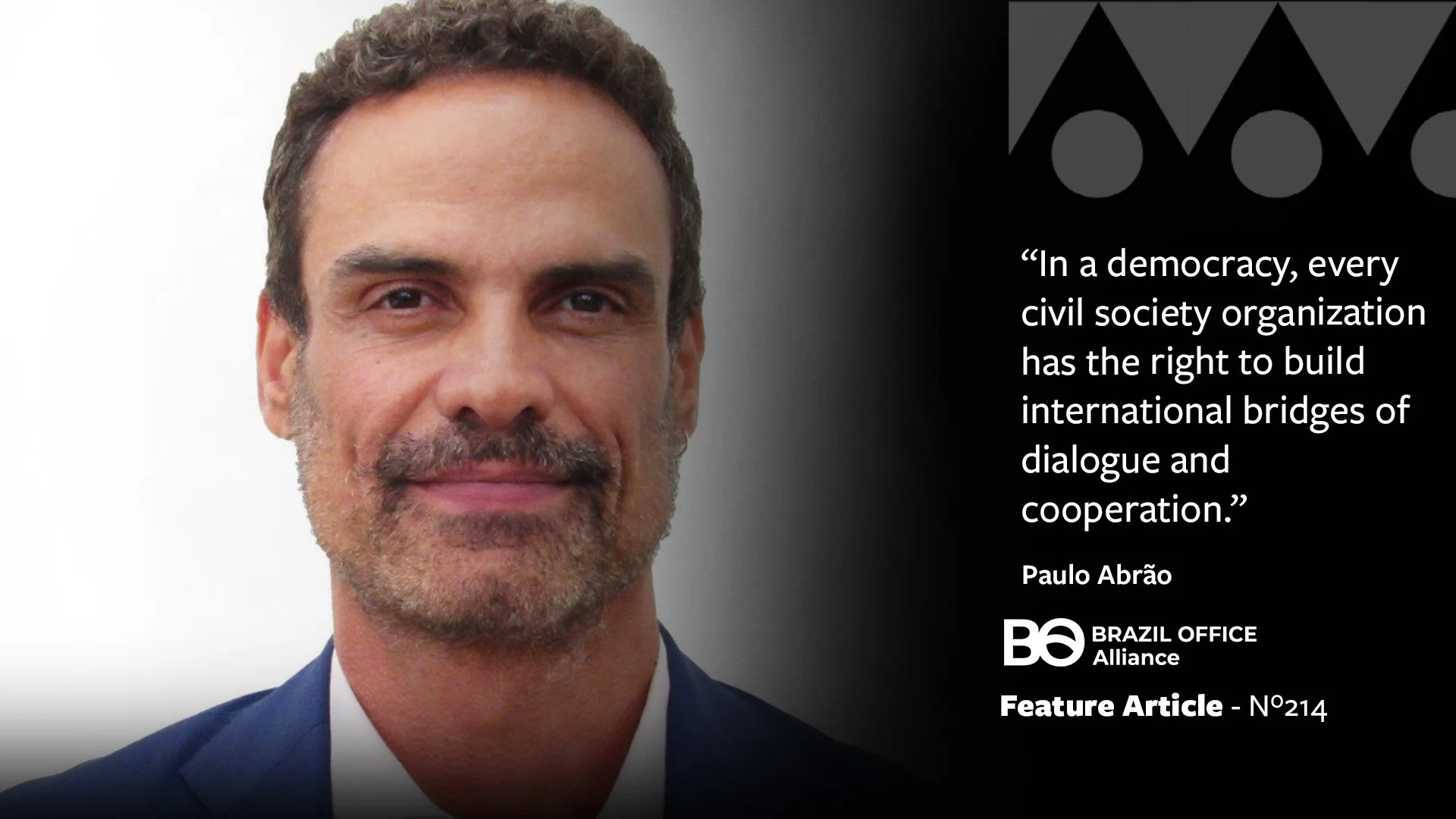
In a democracy, every civil society organization has the right to build international bridges of dialogue and cooperation.
The criterion distinguishing legitimacy from illegality is not the existence of these bridges, but what traverses them.
When the goal is to strengthen democracy, protect human rights, and defend the rule of law, international engagement is not merely legitimate; it represents one of the noblest expressions of contemporary global citizenship.
Conversely, when these same bridges are used to undermine national institutions, promote sanctions against one’s own country, or seek political-electoral advantages through foreign pressure, one leaves the realm of democratic cooperation and enters the territory of illegality and illegitimacy.
*Paulo Abrão is the Executive Director of the Washington Brazil Office (WBO). He served as Brazil’s National Secretary of Justice. He also served as Executive Secretary of the Inter-American Commission on Human Rights of the Organization of American States and as Director of the Mercosur Institute of Human Rights. He was a visiting scholar at the Watson Institute for International and Public Affairs at Brown University.
