
Your Excellencies, the Facts Regarding the Tariff Crisis
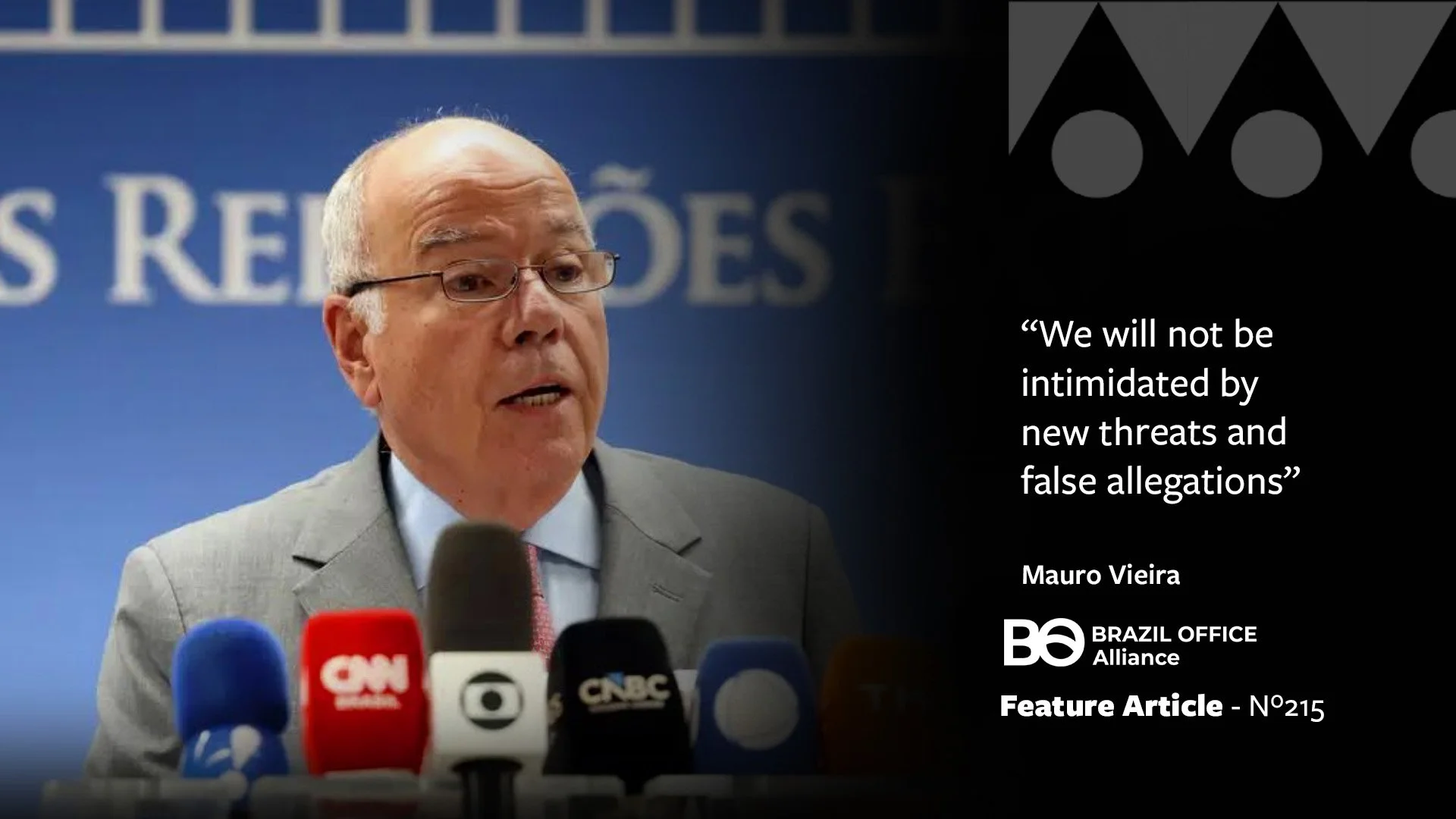
By Mauro Vieira, Brazil’s Minister of Foreign Affairs. This article was originally published in the July 24, 2026, edition of the newspaper O Globo and was kindly provided by the author for reproduction in the Brazil Office Alliance newsletter.
Unanimity is not to be expected in democratic regimes. However, in the face of the United States' new tariff-based attack on Brazil—and the admitted political motivations behind it, dating back to President Donald Trump’s original letter of July 2025 (which contained clear threats to Brazilian sovereignty and democracy and announced the launch of the Section 301 investigation that has now concluded)—there is no room for ambiguity or false equivalencies.
Brazil has been under attack for over a year, and the government has successfully defended the national interest with diplomacy and pragmatism, as well as firmness and clarity. Clarity is precisely what the country needs most as it confronts a historic challenge to its sovereignty—one being imposed from the outside through threats, tariffs, and bluster.
The timeline of the current offensive against Brazil leaves no doubt as to which Brazilians worked against the national interest to secure impunity for those who failed in an attempted coup d'état. These Brazilians, led by former Congressman Eduardo Bolsonaro, continue to push for foreign interference in Brazil. As Ulysses Guimarães might have said, "Your Excellency, the Facts," asserts itself here. The authorship of these threats and the massive tariff hike is not a matter of opinion; indeed, the authors themselves claimed credit for them at the time in posts and interviews.
Faced with the multiple challenges of the past year, the Brazilian government’s primary course of action has been negotiation. Brazil’s willingness to engage is amply demonstrated by more than 30 contacts and meetings with Washington on tariffs, particularly during the Section 301 investigation. Since the original sweeping tariff measure was ruled illegal by the U.S. Supreme Court, invoking Section 301 of the 1974 U.S. Trade Act became the alternative Washington found to maintain unilateral actions—not only against Brazil but also against its major global trading partners, as evidenced by the new 12.5% tariff announced yesterday.
In Brazil’s case—the first to be hit by Section 301 sanctions—the U.S. side never showed any openness to balanced negotiations, even regarding the most glaring instances of interference and specious arguments, such as those concerning Pix and deforestation. What was proposed to Brazil amounted to a form of surrender, involving the full opening of Brazilian industrial sectors exclusively to the United States, without any reciprocal trade-opening measures. The Brazilian private sector has never accepted capitulation on such terms in past foreign negotiations, nor would it ever accept it now. The ethanol issue is a prime example: while the United States demanded significant tariff reductions, it refused even to discuss its own high tariffs on Brazilian sugar—which exceed 80%. This U.S. stance follows a pattern recently observed with other countries, characterized by threats and unilateral actions.
Any unilateral concession granted exclusively to a specific country would be illegal under Brazil’s international commitments to the World Trade Organization and would inevitably be challenged in Brazilian courts by the affected sectors. The terms proposed by the United States—which we tried to reverse until the very end—did not constitute a negotiation, but rather an attempt to impose the law of the strongest. Furthermore, there was a clear political bias, as evidenced by the aggressive social media post from the U.S. Secretary of State, in which he arrogated to himself the right to decide what is best for Brazilians while gratuitously attacking the president of a friendly nation.
We remain willing to negotiate, but we will not be intimidated by new threats and false allegations. It is worth remembering that for dialogue and results to occur, we depend on the other party's willingness to negotiate. Brazilian diplomacy is known for its professionalism and has already succeeded in expanding the list of exceptions to the original massive tariff hike. We will continue working to find solutions to a crisis instigated by Brazilians who operate openly against the country and enjoy protection and political support from sectors of the international far-right. Given the damage caused, we cannot remain silent regarding those behind this interference. After all, Brazil and the Brazilian people are paying a heavy price for this irresponsibility.
