
Why a Delegation of Party Leaders is Going to Washington
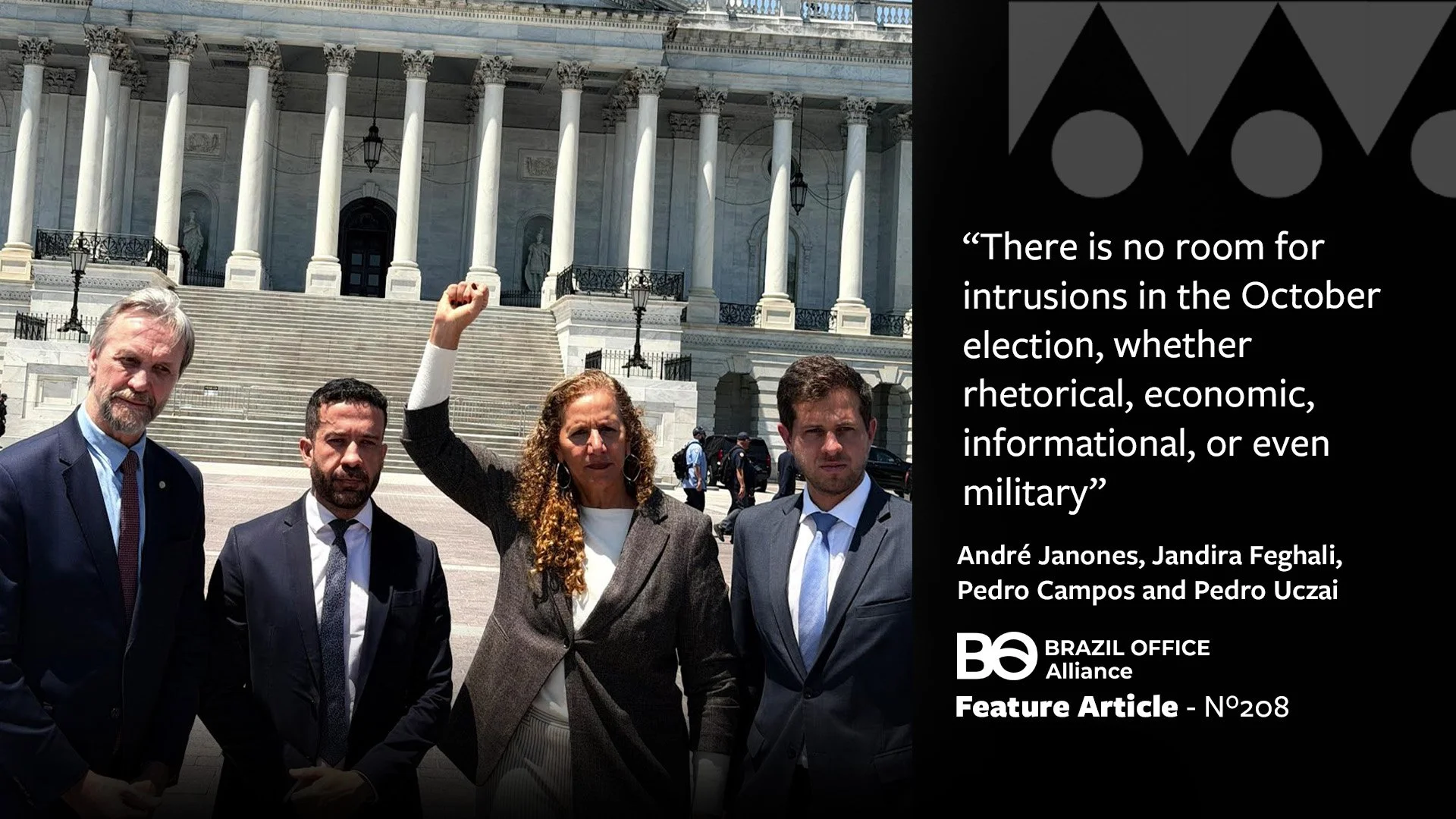
By André Janones, Jandira Feghali, Pedro Campos and Pedro Uczai*
This article was originally published in the online version of the Trends and Debates section of the Folha de São Paulo newspaper on June 1, 2026. To read the original, click here.
This year's election in Brazil is already one of the most internationalized in our history. Since launching his candidacy, Senator Flávio Bolsonaro from the Liberal Party has traveled to Bahrain, the United Arab Emirates, Israel, France, Chile, and, of course, the United States. During the same period, President Luiz Inácio Lula da Silva of the Workers' Part) visited Panama, India, South Korea, Colombia, Spain, Portugal, Germany, and the United States.
Lula's trips abroad have been marked by meetings with heads of state, debates on trade, energy transition, democracy, investment, global governance, and strengthening Brazil's role in multilateral organizations.
In contrast, Flávio Bolsonaro directs his international activities towards political alliances aligned with sectors of global authoritarian conservatism to fuel domestic ideological conflicts. This explains his meeting with US President Donald Trump, where he called for external interventions and interference, delegitimizing the functioning of national institutions, generating risks and uncertainties for the economy, and thus eroding the credibility of Brazil's rule of law abroad, straining our democratic stability.
It is already known that the far right coordinates internationally. In this complex international game, Brazilian congressional representatives from the democratic and progressive camp also have something to say. Therefore, a delegation of party leaders from the government coalition is arriving in Washington to meet with members of the U,S. Congress, diplomats, international organizations, the Inter-American Human Rights System, journalists, academics, and local civil society organizations. In addition to informing and explaining the strengths of our democracy, the delegation will also deliver a clear message against any interference that may exist in the United States in relation to Brazil: there is no room for intrusions in the October election, whether rhetorical, economic, informational, or even military.
Unilateral, non-negotiated measures can weaken the fight against criminals and generate actions that endanger the lives of people who have nothing to do with crime. They can reduce the capacity for information sharing between police forces. They can affect our financial system and national innovations such as Pix, which bother foreign interests.
Brazil is a sovereign country, with a reliable electoral system and a strong and resilient democracy, which only demands three things from its international partners: relations founded on bilateral cooperation and respect for international law, trust in the process and national institutions, and respect for the election results, regardless of who wins. These are the messages we will take together to Washington in this election year.
*André Janones is a federal congressman for the state of Minas Gerais and leader of the Rede Sustentabilidade Party; Jandira Feghali is a federal congresswoman for Rio de Janeiro and leader of the PCdoB party; Pedro Campos is a federal congressman for the PSB party in Pernambuco and deputy leader of the government; and Pedro Uczai is a federal congressman for Santa Catarina and leader of the PT party.
